
Southern Vietnamese Cuisine During the Resistance War
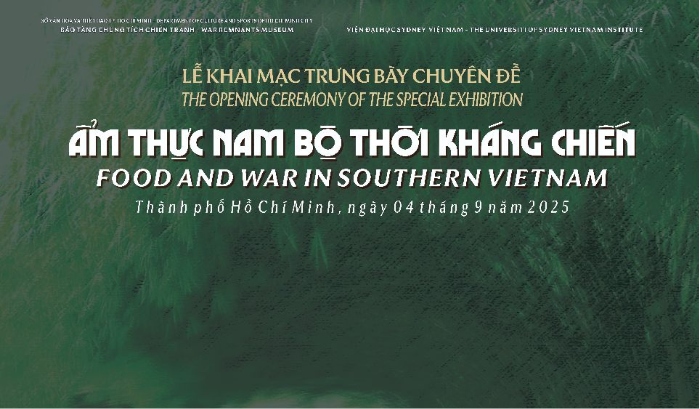
04 Sep – 30 Nov 2025
War Remnants Museum
Ward 6, District 3, HCMC
From the organizer:
The War Remnants Museum will open a new four-month exhibition, “Ẩm thực Nam Bộ thời kháng chiến” | “Southern Vietnamese Cuisine During the Resistance War”, on 4 September 2025. The exhibition invites visitors into an evocative sensory journey where food, memory, and resilience converge to tell stories of survival and solidarity.
Developed in partnership with the University of Sydney’s Sydney Vietnam Institute and led by Associate Professor Jane Gavan and Dr. Phạm Lan Hương (University of Culture, Ho Chi Minh City), the project asks how museums can nourish peacebuilding while engaging with difficult histories. It offers a timely contribution to Vietnam’s cultural reform, in anticipation of the forthcoming Cultural Heritage Law (December 2025) and the Museum Professional Duties Circular (July 2025).
Food, Memory, and Resilience
At the heart of the exhibition is the everyday act of cooking and eating rituals that became lifelines during the southern resistance wars. Visitors can grind rice by hand, guide smoke from a Hoàng Cầm stove, or carry a soldier’s rice caddy and backpack. Recipes, oral histories, and wartime songs shared by veterans, elders, and students animate the galleries with voices often absent from official histories.
“Food is a powerful lens for understanding both survival and solidarity,” says Assoc. Prof. Jane Gavan. “By engaging the senses, we invite visitors to connect with history on a deeply human scale, through memory rather than trauma.”
The exhibition also features spice bags embroidered with an image of each spice by local seamstresses, allowing visitors to smell the distinctive flavours of southern Vietnam and celebrate local crafts people. Selected kitchen implements were lent by grandparents and families of the curatorial intern team, objects that carry histories
passed down across generations.
The Sensory Journey of Wartime Cuisine
The exhibition traces an arc of experience, beginning with the abundant biosphere of southern Vietnam before the war. Besides the fragrant spices, live herbs in pots allow visitors to breathe in the fragrances of herbs used daily in kitchens, while jars of mắm (fermented food) suspended above the gallery release their sharp aromas through a carefully developed technique: fermentations steeped into porous ceramics, then wiped clean, leaving the potent smell without residue. These scents evoke the innovation of families who transformed small amounts of food into maximum flavour.
The story then shifts to the realities of wartime. Two contrasting kitchens—one with ceramic and bamboo implements, the other fashioned from recycled metals—demonstrate the stark changes in daily life. Visitors encounter the Hoàng Cầm oven,
which carried smoke through underground tunnels, and learn how communities sustained soldiers at the front.
The narrative deepens in prison life, where the almond tree provided nourishment, antiseptic properties, and hope. This reimagined precious tree was made using recycled branches and hand-coloured brass leaves, embodying both resilience and beauty.
Finally, the journey closes with peace. A poem recalls a simple final meal of soup shared by soldiers before returning home, and a monumental photograph of a southern mắm plate bursts with colour—celebrating culinary heritage and survival. Around this, hand-painted watercolours of southern plants add an intimate, crafted touch, while a depiction of the independence dinner on the museum lawn situates the story in national memory.
As visitors prepare to leave, they encounter the participatory bamboo grove. Painted stalks line the wall, and each visitor is invited to stamp colourful bamboo leaves, leaving a personal imprint on the shared landscape. Bamboo, a national symbol of resilience and flexibility, becomes a collective gesture of remembrance and renewal—an embodied reminder that food, memory, and peace are carried forward together.
A Quiet Oasis for Reflection
Importantly, Wartime Cuisine has been deliberately designed as the final stop in the visitor’s journey through the War Remnants Museum. Unlike the intensity of earlier galleries, this exhibition offers a calmer, more reflective space where the focus is on resilience, survival, and the ways communities supported one another in harmony with the land.
By the time visitors exit through the bamboo grove to the street, they are invited to carry with them not only knowledge of the past but also a steadier outlook on peace and a more open heart.
A Case Study in Curating Futures
Wartime Cuisine forms a pilot project of the UNESCO-backed Curating Futures program, which promotes inclusive, collaborative curatorial practice in Vietnam. Led by Assoc. Prof. Gavan and Dr. Hương, the program champions the principle “nothing about us without us”, embedding community voices at every stage.
Design and prototyping were co-developed with interns from the University of Architecture in Ho Chi Minh City, while students from the University of Culture collected intergenerational stories. These collaborative processes exemplify a new wave of curating that is dialogical, participatory, and community-embedded—positioning Vietnam as a leader in experimental museology in Southeast Asia.
Assoc. Prof. Gavan expressed her excitement at seeing how much the interns learned and grew through the project. She acknowledged their hard work and celebrated the way the experience has enriched their futures, noting that the skills and insights they developed will carry forward into the next generation of museum professionals. This reflects the alignment with UNESCO’s commitment to education and capacity-building for the future of Vietnam’s museum sector.
The exhibition also builds on the Curating Futures seminars held in Hanoi in November 2024 and in Ho Chi Minh City in July 2025, where curatorial professional practices of public museums were identified, celebrated, and connected with the wider arts and cultural community. These dialogues aimed to strengthen the active role of museums in society and to foster deeper collaboration across the cultural sector.
The program will culminate in a final seminar in Đà Nẵng in early December 2025, where the threads of the earlier seminars and the learnings from Wartime Cuisine will be drawn together. This gathering will shape the next three years of Curating Futures, consolidating Vietnam’s leadership in collaborative, community-embedded curatorial practice.
Expanding the Museum’s Cultural Network
The project has drawn contributions from diverse cultural partners: Nguyen Art Foundation, Dogma Foundation, the Ho Chi Minh City Museum, and local photojournalists, all of whom provided images and archival material. These contributions extend the Museum’s collection and strengthen cross-sector collaboration, reaffirming museums as living parts of their communities.
Supported by the Australian Department of Foreign Affairs and Trade (DFAT), the collaboration has also connected the War Remnants Museum with the Australian War Memorial, strengthening Vietnam–Australia cultural ties and contributing to UNESCO’s Sustainable Development Goals.
Dr. Jane Gavan
Dr. Jane Gavan is an Associate Professor at the University of Sydney, a visual artist and cultural researcher working in Vietnam since 2015, with deep partnerships across the country’s creative and heritage sectors.
She holds a 2024–2025 artist residency at the War Remnants Museum, in collaboration with the Sydney Vietnam Institute. Her work includes Bammunity (2024), a participatory bamboo watercolour project. She co-led a seminar at the University of Culture (Ho Chi Minh City) on creative practice and trauma in 2024.
Jane has also delivered workshops and programmes at the Hanoi Creative Design Festival, organised by UNESCO and the city of Hanoi and the Vietnam Festival of Creativity & Design (VFCD), organised by RMIT University in 2024.
She continues to collaborate with UNESCO and Vietnamese public museum sector on building participatory, community-embedded curatorial practices. Jane is an advisory academic of the Sydney Vietnam Institute.