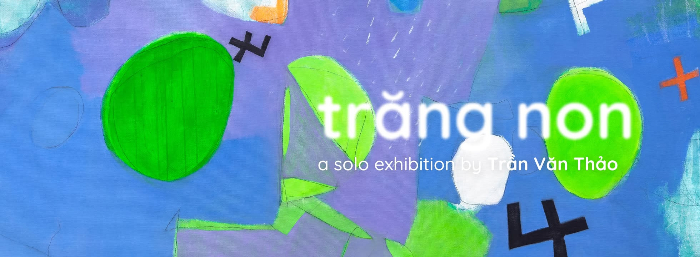
trăng non
10 am – 07 pm, 15 Nov – 27 Dec 2025
Galerie Quynh
118 Nguyễn Văn Thủ, Tân Định, HCMC
From the organizer:
Wanderer moon
smiling a
faintly ironical smile
at this
brilliant, dew-moistened
summer morning,—
a detached
sleepily indifferent
smile, a
wanderer’s smile,—
if I should
buy a shirt
your color and
put on a necktie
sky-blue
where would they carry me?
– “Summer Song” by William Carlos Williams
Galerie Quynh is pleased to present Trăng non, the newest series of paintings by Trần Văn Thảo, one of Vietnam’s foremost abstract painters. The work demonstrates the contemplative and dynamic vernacular that defines his practice: a language spoken in color, gesture, and intuition.
Trăng non literally translates to “new moon”. However, it defies the usual connotations of darkness that a new moon usually suggests. By their nature, new moon nights are darker than others throughout the month. It is a time of introspection often akin to loneliness, when the sky withholds its light. Yet Thảo conveys something different. In Trăng non, his works capture a state of potential, a breath held before the exhale. Not a void, but rather a beginning forming in the dark, gathering strength as it prepares to emerge.
Thảo approaches his title trăng non as he does his paintings: abstractly, and without predetermined meaning. He is drawn simply to how the words sound, treating language itself as abstract form. He does not want viewers to think of a literal new moon when they hear the title. In fact, he doesn’t want them to consider a moon at all. The words are pure sound, pure feeling, divorced from their celestial referents. This refusal to interpret is itself a practice. As Susan Sontag writes in The Aesthetics of Silence, silence is never truly empty; it creates “a full void, an enriching emptiness, a resonating or eloquent silence.” Thảo’s silence around meaning becomes its own kind of speech, asking us to listen more carefully, to find our own relationship with what we see.
Here lies the paradox of any text about Thảo’s work: it interprets where the artist has created space for non-interpretation, adds words to his deliberate silence. Yet silence “remains, inescapably, a form of speech… and an element in a dialogue.” What follows, then, acknowledges its own limitations—not the artist’s explanation, but the viewer’s response to what the work calls forth. Thảo’s paintings ask us to stare rather than merely look, to approach them as one approaches a landscape: without demanding understanding or forcibly seeking significance, but rather offering our presence, our attention unmediated by the need to decode.
This is his most colorful and youthful series yet, a shift in palette that marks the passage of time and where the artist finds himself now. Each body of work carries its own chromatic signature, and trăng non glows with an intensity absent from earlier series, as if Thảo is aging in reverse, growing more vibrant rather than subdued. Works such as “trăng non #18” and “trăng non #22” contain bursts of magenta, neon orange, and yellow that pierce through fields of deep blue like light emanating through a night sky in a storybook. The darkness pulses with life waiting to announce itself. Yet paintings like “trăng non #21,” “#20,” and “#19” offer the inverse—light yellow and white grounds with gestures in black and red, as if the moon itself has turned inside out. Together, they affirm that a new moon in Thảo’s world is not about darkness. Each canvas becomes a site of transformation, where shadow and brilliance coexist, neither canceling the other but creating a third space: possibility itself.
Thảo’s paintings unfold as harmonious dances, choreographed by the body’s wisdom. The number “3,” a backwards “4,” and variations of a “+” sign appear throughout—symbols without fixed meaning, simply representations of feeling, naturally emerging as his hands guide him across the canvas. They are the residue of motion, the trace of a gesture that knew what it needed before thought could name it. There is something to say about this embodied practice: what the artwork makes the body do, and how the body, in turn, shapes what emerges.
Thảo’s paintings speak clearly, and their emotions are unmistakable. He presents them stripped of backstory, without explanation to scaffold the work. This opens a question: what intimacies of life is he pulling from? The immediacy of each canvas suggests he paints from an informed place, a lived place, but he guards the specifics. What remains is the residue of feeling itself, offered to us as an invitation rather than confession.
In the playful and spontaneous landscape of Thảo’s new moon, we find permission. A stare rather than a look– “steady, unmodulated, fixed.” As Sontag writes, “A stare is perhaps as far from history, as close to eternity, as contemporary art can get.” Through accumulated layers of gestures and feelings, we are invited to dream and fall into its power—to suspend disbelief, to trust what has yet to take shape. To dream, after all, is to envision a future brighter than what we can see: an eclipse in reverse, darkness giving way to light we didn’t know was coming.
About artist
Tran Van Thao (b. 1961, Saigon), one of Vietnam’s foremost abstract painters, is recognized for his individual markings, rich colour fields and compositions that convey a sense of harmony and balance through a contemplative atmosphere that invites introspection and mindfulness. For Thao, inspiration comes from the humble yet dynamic experience of everyday life, as well as the immediacy of his surroundings.
Tran Van Thao belongs to an influential group of painters who rose to prominence in the 90s following the 1986 Doi Moi economic reforms. Part of the historic Group of 10 artists that catalysed the process to recognise abstraction as a legitimate genre of the visual arts in Vietnam, Thao was one of the group’s most prominent members.
Thao graduated from the Ho Chi Minh University of Fine Arts in 1986, and has since held numerous exhibitions across Asia, Europe, and the U.S. Selected international exhibitions include Out of Context, Huntington Beach Art Center, Huntington Beach, California, USA; Art Festival for World Peace, Seoul Arts Center, Seoul, Korea; ASEAN Art Awards, National Art Gallery, Kuala Lumpur, Malaysia; On the Horizon, Pacific Bridge Contemporary Southeast Asian Art, Oakland, California, USA; L’Anima Soffocata, Museo Biblioteca Archivio, Bassano del Grappa, Italy; Paris, Hanoi, Saigon: The Adventures of Modern Art in Vietnam, Pavillon des Arts, Paris, France; The Finest Collection from Sister Cities, Busan Metropolitan Art Museum, Busan, Korea; Man and Woman, H&S Gallery, Brussels, Belgium, travelled to Paris, Tokyo, San Francisco, Singapore; From the Red River to the Mekong: The New Trend in Vietnamese Art, Centre Wallonie-Bruxelles, Paris, France; A Winding River: The Journey of Contemporary Art in Vietnam, Meridian International Center, Washington, D.C., USA, travelled to various venues in the United States; 11th International Contemporary Asian Art Exhibition, Metropolitan Museum of Manila, Philippines; Vietnamese Art After Doi Moi, Fujita Vente Art Museum, Tokyo, Japan; 10th International Contemporary Asian Art Exhibition, National Museum Art Gallery, Singapore; and Contemporary Vietnamese Art Exhibition, Tropical Museum, The Hague, Holland. In 2001 he was the recipient of the Asian Cultural Council’s Starr Foundation Fellowship and spent four months as an artist-in-residence in New York.
Thao is currently based in Ho Chi Minh City, Vietnam.
About Galerie Quynh
Galerie Quynh was founded in 2000 by Quynh Pham and Robert Cianchi as a non-profit online educational resource to document and archive the Vietnamese contemporary art scene. A physical space dedicated to a dynamic rotating program of exhibitions opened in December 2003. For over two decades, Galerie Quynh has operated as a hybrid space: a contemporary art gallery and an institution that serves its community through public and educational programs. Collaborating locally and internationally with artists, curators and cultural organizations with diverse creative voices, the gallery has also initiated a number of not-for-profit artist-run community projects such as Sao La led by Nguyễn Kim Tố Lan and Tùng Mai, and CáRô spearheaded by curators Thái Hà and Linh Lê.
Follow updates on event’s page.