
The Sky Stays Green
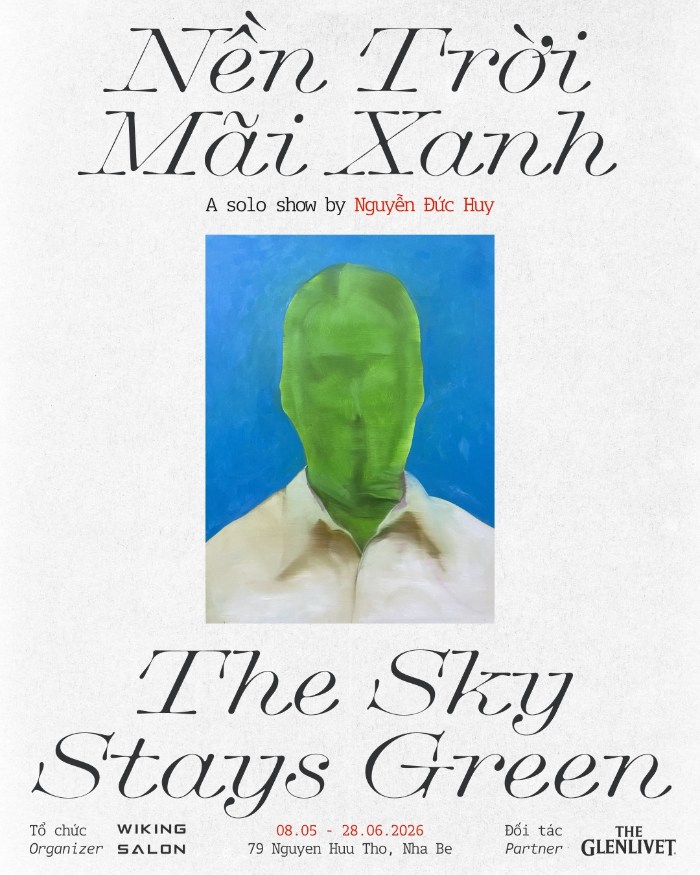
10 AM – 06 PM, Tues – Sun, 08 May – 28 June 2026
Wiking Salon
79 Nguyễn Hữu Thọ, Nhà Bè, HCMC
The presentation is open by advance appointment only
From the organizer:
Wiking Salon is delighted to present a solo exhibition by Nguyễn Đức Huy, Nền Trời Mãi Xanh – The Sky Stays Green.
In Search of the Self on the Green Screen
What lies at the heart of human existence? Identity. It includes both our physical features and the less visible parts of us, like our thoughts and experiences. For identity to exist, we need to be present. To be present means to be seen, remembered, and recognized. But what happens when someone is no longer present? Does their identity slowly fade, or can it disappear completely?
Nguyễn Đức Huy’s solo show The Sky Stays Green brings together oil paintings, video installations, and works on paper. Across these, human figures appear in a simulated world. Chromakey acts as a central visual language and prompts questions about memory, presence, and how identity takes shape in globalization.
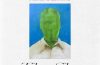
Chromakey, a technique commonly associated with cinematic image construction and the production of visual illusion, functions here as a recurring motif. Faces and bodies, which typically serve as primary loci of identification, are deliberately erased. As a result, the figures enter a paradoxical realm. They are visibly present, yet ontologically incomplete.
The series of work draws inspiration from the artist’s family archives and photographs, including shots captured during weddings, travels and everyday moments. However, during the processes of reconstruction and manipulation, these images have been detached from their original contexts, which destabilized their documentary function. Memory, in this sense, no longer appears as fixed, but rather as contingent and malleable, subject to revision. Such strategies resonate with critical understandings of the archive as a site governed by selection and control.(1) As Jacques Derrida asserts in Archive Fever, the archive is never neutral; it is constituted through decisions about what is preserved and what is excluded. Remembering, therefore, is inseparable from acts of concealment. The act of intervening in such familiar images not only morphs our memory in a particular way, but also exposes its nature, where they are adjusted, negotiated, or reinterpreted.
The repeated deployment of chromakey establishes a cohesive visual language through which individual works cohere into a broader structural system. Within this framework, the identity no longer presents itself in a stable form, but instead as a status that is gradually transitioning into a constant state of changing . This shift may be understood as a form of depersonalization, whereby the individual subject is gradually subsumed into a collective.(2) In this regard, Huy’s practice echoes Judith Butler’s notion of “performativity,” which posits identity not as an inherent nature through repeated actions, but as something constituted through reiterative acts and socially regulated performances. The chromakey figure does not signify discrete individuality; rather, they function as mutable surfaces upon which roles are inscribed. Therefore, the identity does not appear in a natural trajectory , but rather through a more mediated and contingent process. A sense of performativity becomes increasingly pervasive in his works, particularly in the way the scenes are staged. The figures appear in familiar environments, but something is always slightly off: objects seem out of place, the lighting feels artificial, and the lack of interaction between the people and their surroundings. These subtle disruptions make the scenes feel more like constructed sets than lived-in spaces. Hence, each individual is not simply being authentically themselves , but are further shaped by social norms, values, and cultural expectations.. Each gesture, expression, and appearance may feel staged, implying how identity is something we continually act out, adjust, and present to others.
Growing up in the digital age, Nguyễn Đức Huy is inevitably shaped by its visual culture and ways of seeing, whether consciously or not. His works feature vivid colour palettes, including reds, greens, blues, as well as neon pinks and purples, paired with bold and clearly structured compositions. These elements evoke a distinctly digital sensibility, in which images no longer operate as straightforward reflections of reality but as constructs that are produced, circulated, and continuously manipulated.(3)
Alongside the oil paintings, the exhibition also includes video installations and works on paper. The videos foreground movement and temporality, while the drawings offer a quieter, more intimate counterpoint, functioning almost as points of pause within the broader visual flow. Despite their inherent differences, these works remain conceptually aligned, underscoring the coherence and continuity in the artist’s practice.
Ultimately, chromakey has become a symbolic technique for which identity, memory, and absence are considered altogether in the context of the digital age. Here, absence does not simply signify loss, but actively erodes individuality, pointing toward the increasing homogenization of subjects within a world shaped by globalisation and industrialisation.(4) The personal identity is beginning to fade as individuals take on the role of “social actors”, one structured by gender norms, cultural expectations, and the ongoing tension between tradition and change. Within this framework, a central question emerges: what does it mean to be present, and how is identity formed when it can be continually altered, substituted, or performed?
References:
(1) Jacques Derrida, Archive Fever: A Freudian Impression (Chicago: University of Chicago Press, 1995).
(2) Judith Butler, Gender Trouble: Feminism and the Subversion of Identity (New York: Routledge, 1990).
(3) Hito Steyerl, The Wretched of the Screen (Berlin: Sternberg Press, 2012).
(4) Zygmunt Bauman, Liquid Modernity (Cambridge: Polity Press, 2000). Stuart Hall, Cultural Identity and Diaspora.
About the artist
Nguyễn Đức Huy (b. 1995) is a visual artist based in Hanoi, working across painting and video installation. He studied at the Vietnam University of Fine Arts. His practice explores the shifting boundaries between presence and invisibility, identity and anonymity, and the tension between what is revealed and what remains hidden.
A recurring motif in his work is the chroma key–suited figure, a device borrowed from cinematic special effects that both reveals and erases the body, producing ambiguous subjects that question the stability of identity. While his works are often rendered in bright, playful colors, they carry underlying tones of alienation, uncertainty, and psychological dissonance. More recently, his practice has turned toward an investigation of personal and collective memory, using found materials from which he removes individual traces, leaving behind distilled symbolic forms.
Huy has exhibited and screened his work internationally across Vietnam, Japan, Singapore, Indonesia, Germany, Switzerland, Ireland, and Australia. Highlights include his first solo exhibition, Soon the Time Will Come at Á Space, Hanoi (2023), and a group show Virtual Private Realms at Manzi Artspace, Hanoi (2021).
About Wiking Salon
Wiking Salon, founded in 2023, emerges as a dynamic space for contemporary art in Ho Chi Minh City, Vietnam. Dedicated to fostering cutting-edge artistic expression, the gallery serves as a meeting ground for established and emerging artists, curators, and creative minds from around the world. Through thought-provoking exhibitions and dialogues, the gallery fosters a vibrant exchange that reflects the ever-evolving landscape of contemporary art.