
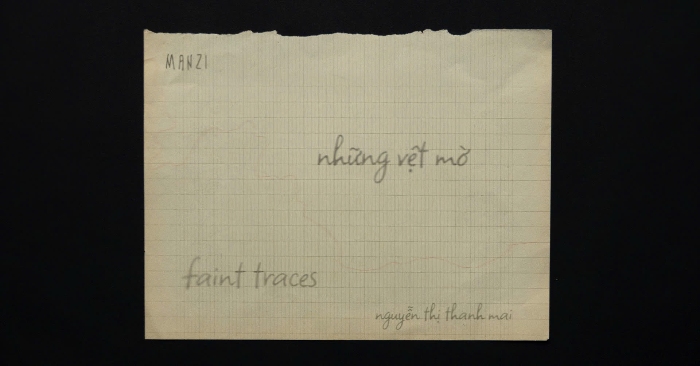
Faint Traces
Opening party: 06:30 pm, Sat 06 Sep 2025
Open studio: 11 am – 07 pm, Tues – Sun 07 – 28 Sep 2025
Manzi Exhibition Space
2 ngõ Hàng Bún, Ba Đình, Hà Nội
From the organizer:
This September, Manzi is honored to present Faint Traces — an open studio by talented Hue-based artist Nguyễn Thị Thanh Mai. This open studio features Mai’s most recent body of work as a further chapter in her decade-long research into the stateless Vietnamese communities residing in Cambodia.
First introduced in July 2025 at the Hiroshima House Art Gallery Project (Phnom Penh), Faint Traces comprises ongoing works across multiple media—video, photography, installation, and drawing. The project mobilizes heterogeneous source materials: colonial and postcolonial maps, archival documents, and expert consultations, as well as the artist’s self-assembled repository of field notes, oral testimonies, site photographs and recordings, and found objects within the community. Through these materials, the open studio revisits the marginal, often erased histories of Vietnamese diaspora communities in Cambodia. The intergenerational trajectories of these communities are inextricably entangled with Cambodia’s histories of colonial domination, armed conflict, and forced displacement, as well as the collective trauma of genocidal violence under the Khmer Rouge regime. Persistently, the community remains structurally relegated to the position of the outsider, if not actively erased, within dominant historical narratives.
Building on her earlier projects concerning identity and belonging based on the specific case of the stateless paracitizens accepted neither by Vietnam nor Cambodia, with Faint Traces, Thanh Mai “makes its way back into their collective memories and oral histories, piecing together a blurred and expansive portrait of migration and displacement, one filled with myth and etched with traces of violence” (excerpt from artist statement). While retracing tributaries back to their source, Thanh Mai resists the impulse to resolve origins, to weave a seamless continuum of meaning. Instead, she allows the materials to appear in their very fractures, obscurities, and dispersions, interweaving experimentations and imaginative interventions. The result is an archive that, while partial and fragmentary, remains mutable: shifting from one iteration of display to another, reassembling provisional points of contact where past events, present emotions, and the rhythms of the exhibition space resonate together.
Yet, might such an endeavor remain no more than an effort to stitch together shards and fragments, flickering recollections, and unrealized dreams? Precariousness and estrangement are inescapable conditions, as all agents involved—the community itself, the artist, the researcher, and the spectator—inhabit the position of the outsider. Within this framework, Mai’s own stated aim “to keep these stories from dissolving into water” raises a critical question: what forms of resonance might persist?
Perhaps precisely when the faint traces are seen, though they endure only as residue of what has already evaporated—irreversible, irretrievable—the void/blank space around them comes into being and becomes perceptible. And through that act of re-narration and re-imagining (painful as it is, often futile as it seems), the traces still bear witness to a life once lived. Was it not Dostoevsky, through his dreamer in White Nights, who confronted us with the question, “How can you ever live if you have no history/no stories to tell?” As for that remaining blank space—though obscure—it may, once recognized, still harbor the possibility that one day dreams might take root, and futures yet unformed might sprout and anchor themselves.
Follow updates on event’s page.