RE:FORM
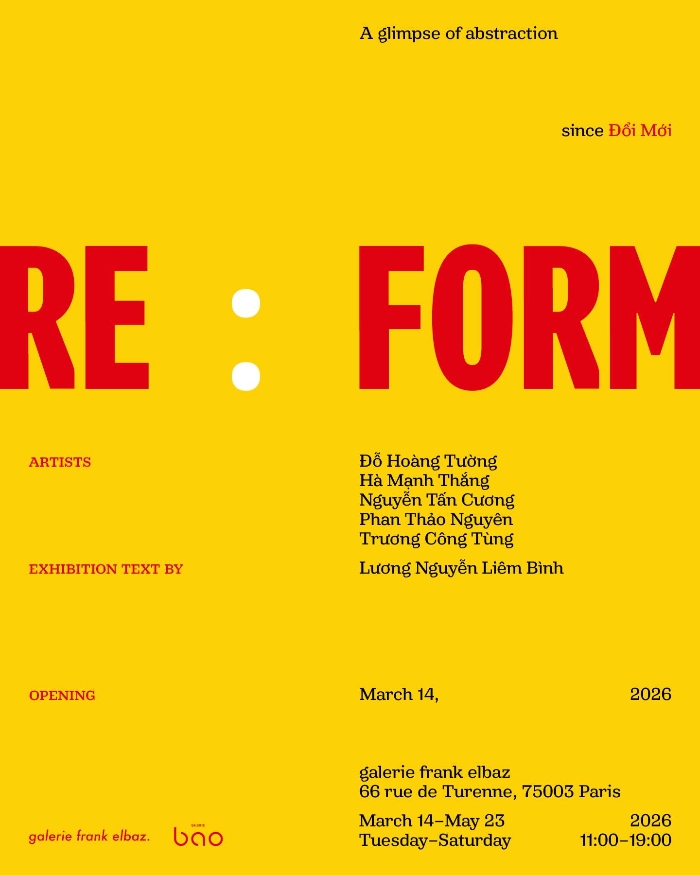
11 AM – 07 PM, Tues – Sat, 14 Mar – 23 May 2026
galerie frank elbaz
66 rue de Turenne, 75003 Paris
From the organizer:
Abstraction in Vietnam is not a thing of the past, nor a belated extension of Western modernism. On the contrary, it constitutes one of the most enduring and progressive artistic approaches underpinning the foundations of the country’s contemporary art. As art historian Pamela N. Corey observes, although abstraction has never formed a unified field of discourse and was long absent from official art historiography (largely written from a Northern Vietnamese perspective), it nonetheless remained a space in which artists sought new visual languages to navigate the spiritual, political, and material transformations brought about by the Đổi Mới cultural and economic reforms of 1986.
After Đổi Mới, abstraction emerged as a form of liberation from socialist didacticism, as well as from the inherited anxieties of Western modernist debates. For artists in Southern Vietnam who continued to work after the end of the war in 1975 but had been compelled to abandon abstract expression, returning to abstraction also became a way to reclaim artistic freedom and to resume a creative trajectory that had been abruptly interrupted. Here, abstraction functions both as an aesthetic movement and as an act of resistance.
Presented at Galerie Frank Elbaz in Paris in collaboration with Galerie Bao, the exhibition Re:form is structured around this spirit of freedom. It traces the practices of five Vietnamese artists who, since Đổi Mới, have returned to abstraction while breaking away from its earlier conventions.
Nguyễn Tấn Cương (b.1954) and Đỗ Hoàng Tường (b.1963), two members of the pioneering Group of Ten (1) that championed abstract practices in the early 1990s, have since taken divergent artistic paths.
In Nguyễn Tấn Cương’s work, the cramped urban spaces of his early period have gradually transformed into an interior world of luminous, atmospheric suggestion. From the series “Inner Strata,” to “Outer Field” he continues to construct a language of abstraction grounded in inner landscapes and primordial gestures rather than a clearly defined philosophical system.
Đỗ Hoàng Tường abandoned abstraction, which he once called a “whisper,” in the early 2000s in order to return to visceral corporeal forms that he describes as a “shout.” The human figure in his work appears within fictional settings, in postures marked by restlessness and conflict between release and constraint. Ultimately, is creative freedom truly the final destination for the artist?
A younger generation, including Thảo Nguyên Phan (b.1987) and Trương Công Tùng (b.1986), approaches abstraction as a way of sensing rather than describing, extending it into conceptual practices, video, installation, and ecology.
In “Forêt, Femme, Folie”, Thảo Nguyên Phan transforms the historical archives of missionary-anthropologist Jacques Dournes into a shadow-play projection suspended in a dreamlike atmosphere, where signs are inverted and transparent interpretation is resisted. Édouard Glissant refers to this principle as “opacity”, the right to remain not entirely legible. Thảo Nguyên employs opacity to render a myth and a history that coexist, intertwine, and persist through drifting layers of mist.
Trương Công Tùng constructs living structures from soil, resin, plants, and belief systems, expanding abstraction into worlds of spirits, climates, and cosmologies. His work “Day Wanes…, Night Waxes…” functions like the trace of an archaeological process, searching for the footprints of the cosmos. Standing beside it, “Long Long Legacies…” is a continuously transforming “sculpture” that changes with each installation, woven from thousands of wooden beads sourced from industrial and forest trees cut down across the Central Highlands during the economic expansion that followed Đổi Mới.
From Hanoi, artist Hà Mạnh Thắng (b. 1980) is seen as significant by the generation that stepped through the door opened in 1992. His gradual shift from figuration to de-figuration unfolds like a meditative journey. For him, abstraction is a temporal field in which history is not depicted but eroded, layered, and reconfigured. The series “The Ancient Monastery Walls” gathers from the faded surfaces of Baiju Monastery in Gyantse, Mongolia, an anchor upon which he layers a sense of compassion for the Sixth Dalai Lama, the only Dalai Lama said to have loved.
Re:form proposes that to look at abstraction in Vietnam is to look directly at the contemporary, with all its ruptures, fluidities, and unfinished possibilities. It is constantly reshaping itself in response to the cultural, political, and ecological shifts of the country. In this context, abstraction is not a universal style borrowed from the West but an aesthetic response to the complexities of post-socialist life, the afterlives of war, and the intensifying pressures of modernization and global exchange.
About the artists:
Nguyễn Tấn Cương (b. 1953, Hanoi; lives and works in Ho Chi Minh City) is a leading figure of abstract painting in southern Vietnam. He began painting at an early age and graduated from the National School of Fine Arts in Saigon in 1973, shortly before the Fall of Saigon in 1975, a formative historical moment that shaped his generation.
After initial explorations in abstraction during the 1980s,Nguyễn Tấn Cương fully committed to the movement through his participation in the influential Recent Works exhibitions with the Group of 10 between 1991 and 1996. His paintings are characterized by expansive spatial compositions, vibrant and contrasting colours, and dense, interwoven layers of gestural movement. Rather than representation, his work emphasizes emotional states, rhythm, and the physical energy of painting itself.
With over three decades of sustained practice, he has established as a central voice in Vietnamese abstraction, alongside artists such as Nguyễn Trung, Ca Lê Thắng, Đỗ Hoàng Tường, and Trần Văn Thảo. His works are held in public and institutional collections including the Vietnam Fine Arts Museum (Hanoi), Ho Chi Minh City Fine Arts Museum, Da Nang Fine Arts Museum, Biblioteca Archivio (Italy), H&S Collection (Belgium), Post Vidai Collection (Switzerland–Vietnam), and the Town of Olds Public Sculpture Collection (Canada), among others.
Đỗ Hoàng Tường (b. 1960, Quảng Nam; lives and works in Ho Chi Minh City) is a major figure of Vietnam’s post-war generation of painters and a founding member of the influential Group of 10, which played a key role in the development of abstract art in southern Vietnam during the 1990s. His early practice emerged in the context of historical rupture and social transition, shaped by the psychological legacy of conflict.
Since the early 2000s, Tường has returned to figurative painting, developing a powerful visual language centered on the wounded human body. His distorted and contorted figures, often charged with erotic tension and emotional intensity, confront trauma, memory, and the fragility of human existence. For the artist, painting functions as a process of repair—an attempt to negotiate history through embodied experience.
His work has been presented internationally in major exhibitions including Personal Structures at the European Cultural Center (Venice), Ties of History: Art in Southeast Asia (Manila), Open Door – Fine Arts after Đổi Mới at the Vietnam Museum of Fine Arts (Hanoi), and S.E.A Focus at Gillman Barracks (Singapore). His works are held in public and institutional collections including the Singapore Art Museum (Singapore), Vietnam Museum of Fine Arts (Hanoi), Ho Chi Minh City Fine Arts Museum, The Outpost (Hanoi), Nguyễn Art Foundation (Ho Chi Minh City), Post Vidai (Vietnam–Switzerland), among others.
Trương Công Tùng (b. 1986, Đắk Lắk; lives and works in Ho Chi Minh City, Vietnam) is a leading contemporary artist whose practice explores ecology, cosmology, and cultural memory. Raised in Vietnam’s Central Highlands, his research engages belief systems, environmental change, and the cultural consequences of modernization. Working across video, installation, painting, sculpture, and found materials, he constructs speculative narratives where science and mythology intersect.
Tùng is a founding member of Art Labor (est. 2012), a collective operating between visual art and the social and life sciences. He has presented major solo exhibitions at the Hamburger Kunsthalle (Hamburg), Museion (Bolzano, Italy), Canal Projects (New York) and the Jim Thompson Art Center (Bangkok, Thailand). His work has been featured in the 36th São Paulo Biennale, the 58th Carnegie International, Taipei Biennial, Dhaka Art Summit, and Centre Pompidou (Paris). He is among the winners of the Arnaldo Pomodoro Sculpture Prize 2026 in Milan. His works are held in public and institutional collections including MUSEION (Bolzano), KADIST (Paris and San Francisco), the Institute of Contemporary Art (Los Angeles), MoMA Poland, Aura Contemporary Art Foundation (Japan), Nguyễn Art Foundation, The Outpost (Hanoi), Post Vidai, and the Yan Du Collection (London).
Thảo Nguyên Phan (b. 1987, Ho Chi Minh City, Vietnam) is a leading contemporary artist whose practice explores memory, ecology, and the layered histories of Vietnam. Trained in lacquer and silk painting, she works across film, installation, sculpture, textiles, and books, developing a poetic visual language in which painting expands into cinematic and spatial forms. Her narratives intertwine reality and fiction, drawing on literature, philosophy, and ancestral tales to reflect on colonial legacies, environmental transformations, and the unconscious dimensions of history.
She has presented major solo exhibitions at the Palais de Tokyo (Paris), Pirelli HangarBicocca (Milan), Kunsthal Charlottenborg (Copenhagen), Tate St Ives, WIELS (Brussels), and Fundació Joan Miró (Barcelona). Her work has been featured in the Venice Biennale, Manifesta, Kochi-Muziris Biennale, Lyon Biennale, and Sharjah Biennale. She is a founding member of the Art Labor Collective (2012) and a former participant in the Rolex Mentoring Programme under Joan Jonas.
Hà Mạnh Thắng (b. 1980, Thái Nguyên; lives and works in Hanoi, Vietnam) is widely regarded as a key voice of Vietnam’s post–Đổi Mới generation of painters. His practice explores time, materiality, and existential experience. His early works employed vivid colours and pop-inflected imagery to reflect Vietnam’s social transformations and the rise of consumer culture. Over time, his research shifted toward a more meditative approach, focusing on the physicality of paint. Through heavy impasto and tactile surfaces, his canvases evoke elemental substances such as soil, stone, and wood, transforming painting into a sensory record of memory and impermanence.
His work has been presented in major institutional exhibitions including Post Đổi Mới: Vietnamese Art After 1990 at the Singapore Art Museum and Connect: Kunstzene Vietnam at ifa Galleries, Berlin and Stuttgart. His works are held in public and institutional collections including the National Art Museum of China (Beijing), Singapore Art Museum, Vietnam Fine Arts Museum (Hanoi), Nguyễn Art Foundation (Ho Chi Minh City), and RMIT University Vietnam, among others.
About the galleries:
Founded in 2002 in Paris, galerie frank elbaz is dedicated to championing the work of international artists across generations. The gallery is committed to both supporting contemporary creation and reintroducing significant historical figures, while also representing artist estates. Through collaborations with curators and artists, galerie frank elbaz develops ambitious exhibition projects and maintains a strong presence at leading art fairs worldwide.
In recent years, the gallery has strengthened its longstanding relationship with Japan, actively promoting Japanese artists on the international stage. It has also expanded its presence locally by presenting a dynamic programme of exhibitions in Tokyo and Kyoto, reaffirming its commitment to cultural dialogue and artistic exchange.
Galerie Bao was founded by Lê Thiên-Bảo, a Vietnamese curator recognized for her sustained commitment to contemporary art from Southeast Asia since 2016. Acting as a close ally to artists, the gallery is dedicated to building long-term, sustainable relationships that support the ongoing development of their practices. Moving beyond the conventional exhibition model, Galerie Bao fosters collective dialogue and encourages experimental and critical thinking.
The gallery collaborates with an extensive network of institutions and public collections, including the Palais de Tokyo (Paris, France), MUSEION (Bolzano, Italy), Han Nefkens Foundation (Madrid, Spain), MASS MoCA (North Adams, United States), Kadist Foundation (San Francisco, United States, and Paris, France), POUSH (Aubervilliers, France), The Outpost (Hanoi, Vietnam), and the Nguyen Art Foundation (Ho Chi Minh City, Vietnam), among others.
(1) The Group of Ten (1989–1996) comprised Nguyễn Trung, Ca Lê Thắng, Đào Minh Tri, Nguyễn Tấn Cương, Nguyễn Thanh Bình, Hứa Thanh Bình, Nguyễn Trung Tín, Đỗ Hoàng Tường, Trần Văn Thảo, and Vũ Hà Nam. Active primarily in Ho Chi Minh City, they were among the first to openly experiment with abstraction at a time when Socialist Realism remained the only officially sanctioned visual language in Vietnam. Their annual “Recent Works” exhibitions in the early 1990s played a pivotal role in legitimizing non-figurative practices, culminating in the official state recognition of abstract art in 1992. Though the group dissolved by the late 1990s as each artist pursued an individual path, their collective spirit and commitment to artistic freedom continue to influence younger generations.