
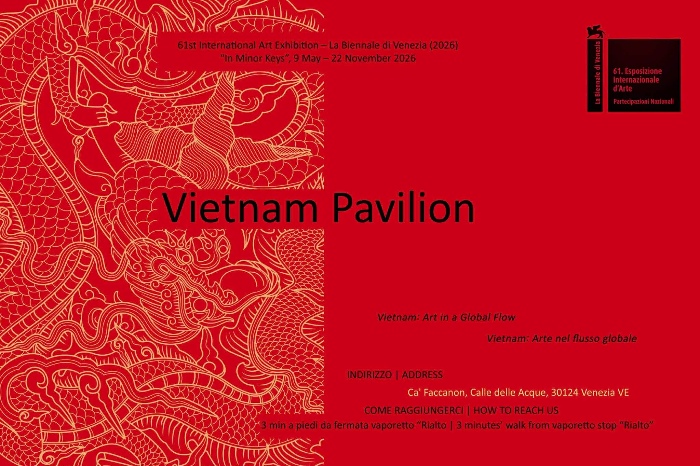
Vietnam: Art in a Global Flow
May – Nov 2026
Vietnam Pavilion
The 61st International Art Exhibition – La Biennale di Venezia
Venice, Italy
From the organizer:
Participating artists: Lê Nguyên Chính; Bùi Hữu Hùng; Đoàn Thị Thu Hương; Công Kim Hoa; Lê Hữu Hiếu; Nguyễn Trường Linh; Lê Hoàng Nguyên; Oanh Phi Phi; Triệu Khắc Tiến; Trịnh Tuân
Curator: Đỗ Tường Linh
As part of La 61. Esposizione Internazionale d’Arte della Biennale di Venezia, Vietnam officially presents its national pavilion for the first time with the exhibition “Vietnam: Art in a Global Flow”. On view from May to November 2026 in Venice, Italy, the exhibition marks a significant milestone, affirming the presence of Vietnamese art within one of the most prestigious and influential platforms of contemporary art worldwide.
Organized by the Ministry of Culture, Sports and Tourism, the pavilion brings together ten Vietnamese artists who explore lacquer (sơn mài) as a central medium. Each approaches lacquer from a distinct perspective—from painting to installation, from traditional techniques to expanded spatial and structural explorations. Characterized by layered material processes and a richly nuanced palette, the works offer multi-dimensional visual experiences in which image, light, and material interact in close dialogue.
Within this context, lacquer is presented not merely as a craft technique, but as a culturally rich artistic language capable of adapting to contemporary concerns. It emerges as a living practice, reflecting the cyclical rhythms of life and the sustained, meticulous labor of the artist.
The exhibition also enters into dialogue with the Biennale’s overarching theme, “In Minor Keys”, evoking the tonal qualities of minor chords—resonances that echo from within. This spirit aligns with the practice of lacquer: a process of repetition between layering and polishing, where patience and precision accumulate into depth and enduring resonance.
As Vietnam makes its debut at the Biennale, “Vietnam: Art in a Global Flow” does not seek to assert itself through scale or declaration. Instead, it extends a quiet invitation: to listen to subtle voices, to dwell in stillness, and to reflect on the capacity to sustain creative energy within an ever-evolving and multifaceted art world.