

Working at the Speed of a Gesture: The Practice of Tony Noël
Written by Hang Nguyen for Hanoi Grapevine,
Photos provided by Tony Noël
Please credit Hanoi Grapevine when sharing.
No reproduction in part or whole without prior permission
Tony Noël had his first solo exhibition “Movement is Art” (curated by Chau & Co Gallery Director Hoàng Minh Châu) in Vietnam last November as part of Photo Hanoi’ 25. This April 2026, Institut français du Vietnam in Ho Chi Minh City is going to host another solo exhibition by Tony Noël showcasing a series of photography works taken during his time in Hanoi and Ho Chi Minh City last year with further details to be posted soon!
Born in 1993 and raised in Lyon, Tony Noël did not grow up within an artistic milieu, nor within a cultural environment that suggested a creative profession as a realistic future. His childhood, however, was full of making. From the age of six he drew constantly, copying anime figures, experimenting with graffiti forms, folding origami, and building imagined structures from Lego. These activities did not initially point toward a vocation; they functioned simply as ways of occupying time and attention. Later, music became equally important, and for a period he imagined himself as a DJ playing funk rather than as an image-maker.
Photography entered his life almost accidentally. At sixteen he purchased a small Hewlett-Packard camera on eBay and used it occasionally, mainly to make pleasant images for friends and family. Nothing in these early experiences indicated a professional direction. Even during a trip to Portugal in 2014, when he photographed both his holiday and a badminton match and was encouraged to continue shooting, photography still remained a possibility rather than a commitment. At that time Tony was employed in a factory. The position was stable and he advanced within it, eventually becoming chief of staff, yet the work offered little sense of future. The routine was repetitive and calculable, organized around the exchange of time for income.
Borrowing a professional camera from a friend altered his perception not because of improved image quality but because of the possibility it represented. The camera suggested a different form of labor. Tony therefore set himself a deadline: two years to make a living from photography, after which he would abandon the attempt. The decision was pragmatic rather than romantic. He did not describe it as a choice to become an artist but as an attempt to spend his life doing something he genuinely liked. This background remains central to understanding his practice, because Tony photographs with the mentality of someone formed by industrial labor but attempting to redirect it.
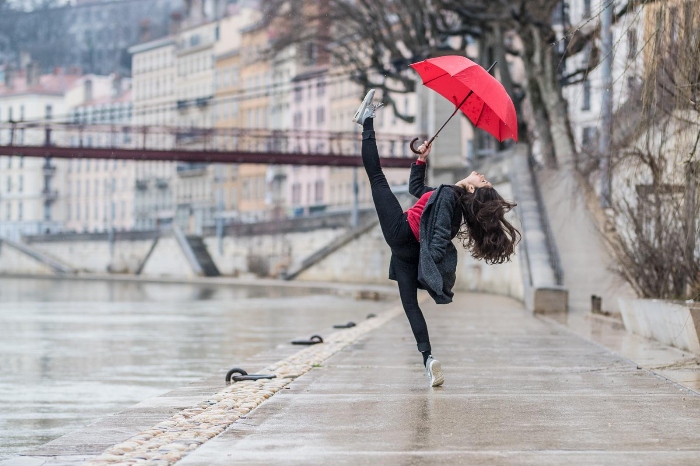
This image is one of my first iconic photographs, the one that helped me gain visibility on social media and marked my first meeting with Sigma, my historical partner since 2016. I became interested in classical dance by studying movement with young dancers from Lyon Conservatory and Maurice Béjart School in Lausanne.
Speed as Method
Tony frequently explains his practice through the idea that he thinks quickly. Drawing and painting, which he still pursues, require time for construction and revision, whereas photography allows him to register an idea before it disappears. The image is not designed in advance but emerges in the brief interval where perception and action coincide. For him, hesitation weakens emotion, and prolonged preparation risks losing the initial impulse that made the image necessary.
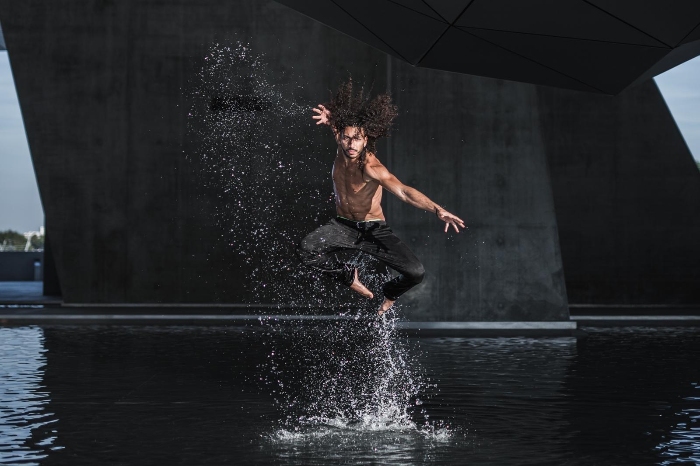
Walid Boukabache, a dancer friend close to my family, invited me for a shoot at Musée des Confluences. We were not allowed in the basin and security quickly stopped us, but the image was already captured.
Speed in this context is not a stylistic flourish but a structural condition. Emotion, movement, and attention each have a limited duration, and the photograph must occur within that temporal window. This understanding explains his long engagement with dancers. A dancer’s posture never repeats itself exactly; balance, tension, and direction shift from second to second. Repetition produces a pose, but not the moment. The photographer therefore cannot slow down the process; instead, he accelerates his own perception to meet the dancer’s movement.
During a session Tony prepares only the basic conditions—the space, the available light, and the frame. He then counts briefly and allows the dancer to move. Composition is adjusted simultaneously with the action, and the image may appear within seconds or only after a longer period of observation. The work relies largely on improvisation, not on choreography. Rather than directing gestures, he responds to events as they unfold.
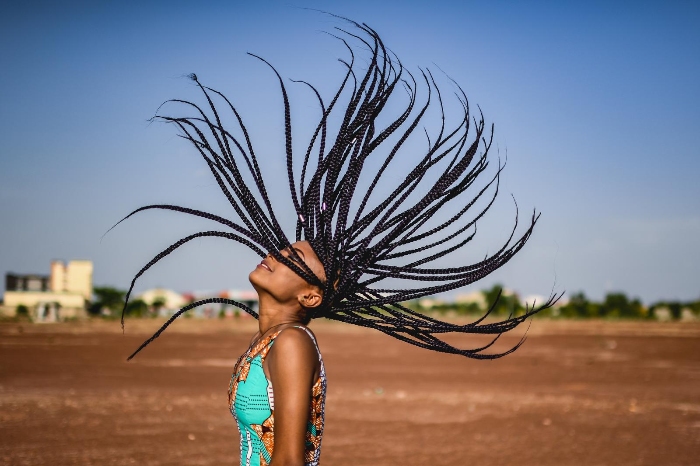
Taken in Burkina Faso in 2018 during a report assignment. I missed my first flight and then lost my luggage containing almost all my equipment. I worked for six days with only one camera body, one 35 mm lens and two batteries.
Efficiency and the Industrial Eye
A paradox emerges in this working method. The speed and repetition of Tony’s practice resemble industrial efficiency, and his language often emphasizes discipline and labor. When teaching younger photographers he offers practical advice rather than mystification, insisting that progress depends primarily on sustained work. His experience in the factory remains visible here, shaping his understanding of image-making as a continuous process rather than an exceptional moment of inspiration.
He photographs frequently, meets collaborators regularly, and treats the camera as a working instrument rather than a precious object. Although he uses professional equipment, he repeatedly insists that composition and light matter more than the price of the camera and that strong images can be made with simple tools. In this sense his practice reflects a logic associated with productivity: repetition, adjustment, and incremental improvement. He learned photography not through formal schooling but through accumulation—encounters, attempts, errors, and corrections. His network of dancers and collaborators developed through social media and personal contact, functioning less as a closed artistic studio than as an open professional ecosystem.
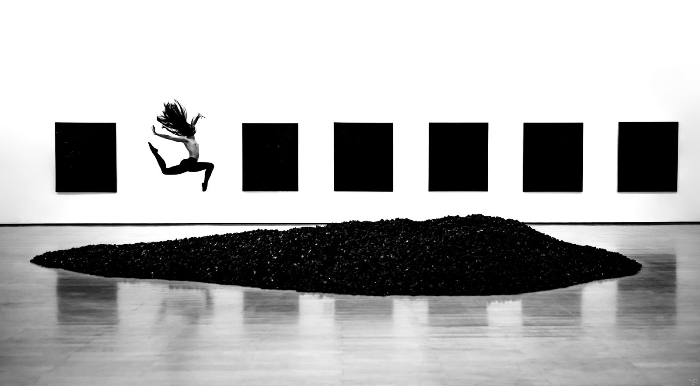
With Naïs Arlaud (Jean-Claude Gallotta Company), this image reinterprets a work by Bernar Venet, later approved by the artist himself. Captured in less than five minutes.
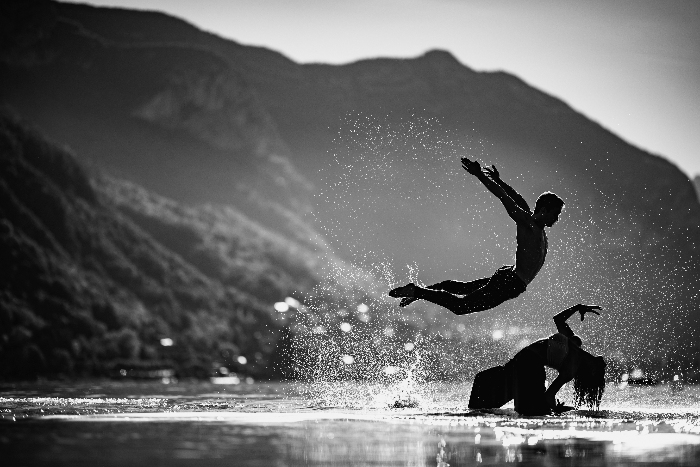
Created during a masterclass in Annecy, when the lake level was exceptionally low. Originally intended as a simple backlight composition demonstration.
Yet the result of this efficiency is not mechanical imagery. Instead, it produces images attentive to fragility. Because his working process is rapid, the photographs attend to extremely small intervals of time. Rather than fixing a dancer into a stable pose, Tony photographs the instability between poses, when a body is still forming its gesture. After working with many individuals, he reports being able to sense quickly which movements suit a person and which perspectives reveal their energy. This intuition allows him to operate with minimal verbal instruction. Participants often describe the sessions as unexpectedly intimate, since communication occurs through movement rather than speech.
The camera therefore functions less as a recording device than as a mediator between two actions. The dancer moves, the photographer reacts, and the image forms within their interaction. Movement becomes central to his aesthetic not merely as subject matter but as a compositional principle. Lines produced by limbs and torsion replace static arrangements, and even portraits depend upon small shifts of weight or direction. The photograph does not capture the climax of motion but the moment before or after it, when tension remains visible.
Tony’s early engagement with graffiti and urban culture continues to inform his practice. Public spaces—squares, stations, and streets—frequently serve as settings, and his work has extended into public installations, including large-scale prints and images applied to tramways circulating through Lyon. In such contexts photography leaves the gallery and reenters everyday circulation, echoing the urban environments where many dance forms originate.
He does not frame this movement as a theoretical project; rather, he understands drawing, graffiti, and photography as different temporal expressions of the same impulse. Recent works combine these media through collage and layered images, reconnecting his present practice to childhood activities while transforming them through experience.
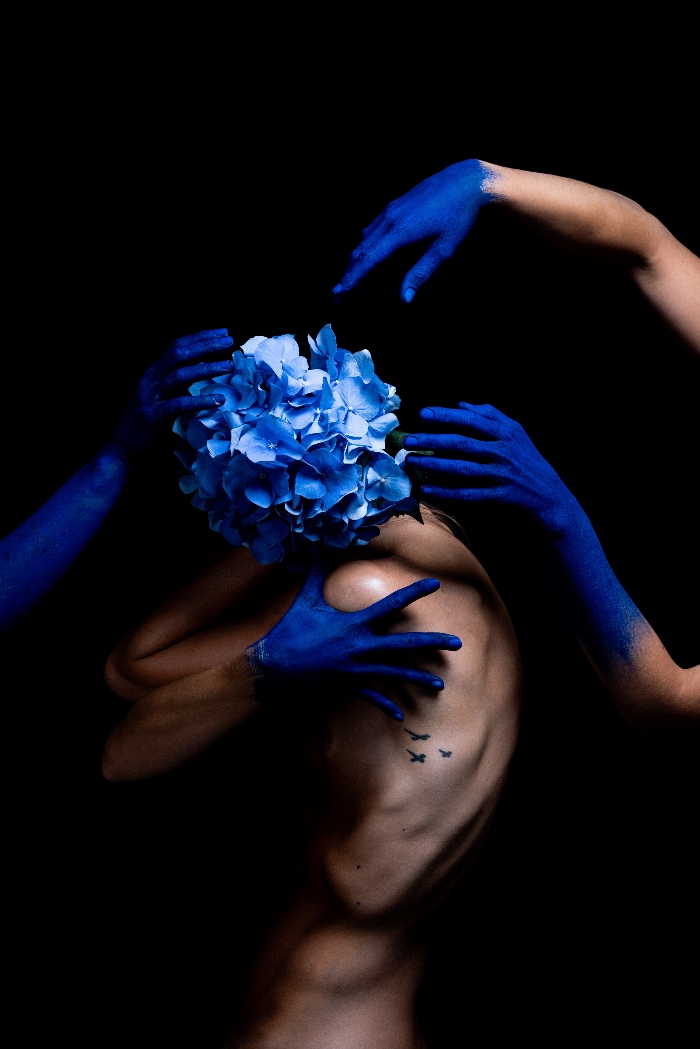
Contemporary series created with Emilie Carasco, cyanotype specialist, and Naïs Arlaud. This project led to a book published by Snap Collective and my first international exhibition in Hanoi.
Despite professional recognition, Tony maintains a modest relation to his equipment. He generally carries only two cameras that he knows intimately, valuing familiarity over technical novelty. The camera becomes comparable to a worker’s tool, meaningful through use rather than prestige. Encounters, rather than apparatus, remain central to his understanding of photography. He recalls meeting a street photographer whose camera mattered less than the conversations it enabled, reinforcing his belief that photography is fundamentally social and collaborative.
This emphasis clarifies his affinity with dance. Dance exists only in presence and cannot be postponed or fully repeated. The photograph therefore functions as evidence of a shared moment rather than a staged construction.
Tony’s work ultimately occupies a tension between two temporal systems. One derives from industrial labor, emphasizing persistence, repetition, and disciplined effort. The other belongs to performance and gesture, defined by fleeting and unrepeatable moments. He works quickly not in order to produce more images but to prevent the disappearance of what cannot be recreated. Efficiency becomes a method for protecting immediacy.
Photography changed his material circumstances, providing travel, income, and public commissions, but its deeper effect lies in altering his experience of time. Instead of measuring days through hours of labor, he measures them through instants in which movement, light, and perception briefly align. Within that interval the discipline of work and the sensitivity of art converge, and the photograph appears precisely at that meeting point—at the speed of a gesture.