
The Red Chair
10 AM – 06 PM, Tues – Sun, 08 May – 28 June 2026
Wiking Salon
79 Nguyễn Hữu Thọ, Nhà Bè, HCMC
The presentation is open by advance appointment only
From the organizer:
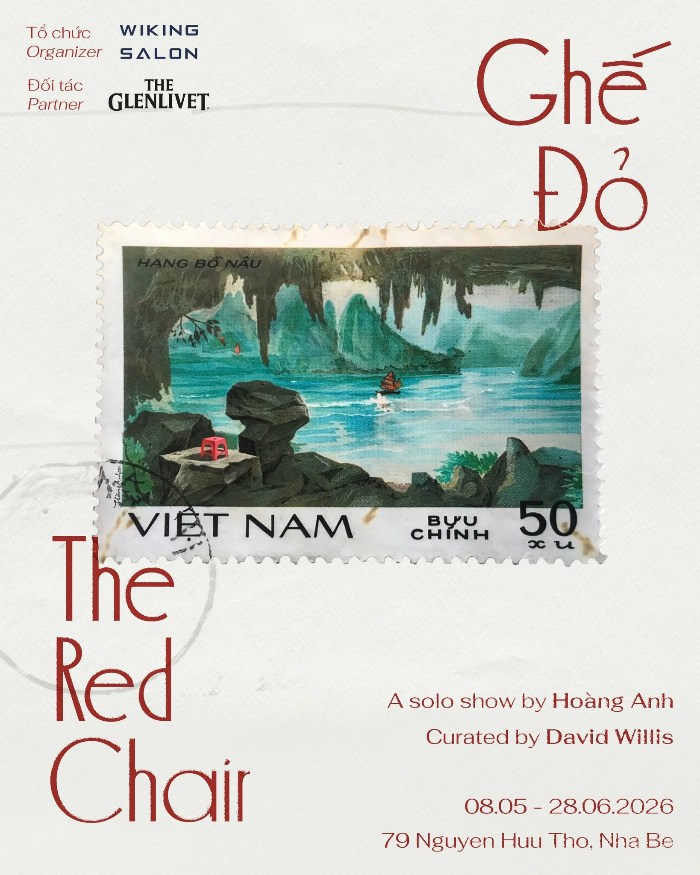
Wiking Salon is delighted to present Ghế Đỏ – The Red Chair, Hoang Anh’s second solo exhibition with the gallery, curated by David Willis, featuring a new series of works on paper.
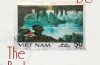
Building upon his celebrated painting series The Outlandish Landscape, in which the artist inserted the red plastic chairs so commonly seen on the streets of Vietnam into nature scenes and historic locations, Hoang Anh here revisits the same theme in a new context. Working with reproductions of historic Vietnamese stamps dating back to the early days of modern Vietnamese sovereignty, he digitally scans the stamps and reprints them at a larger scale, then hand paints a red chair into each scene.
The original stamps were sourced from various private collections and archives. By digitally reproducing the stamp images and subtly modifying the enlarged prints through the addition of the painted chairs, Hoang Anh creates an uncanny time warp effect, where the present bleeds into the past and vice versa. What we see here is a celebration of Vietnamese material culture and the indefatigable spirit of the Vietnamese people, both in their fight for independence across the ages, and in their efforts to modernize their country and uplift their common man — themes which were first celebrated in the masterfully rendered socialist realist artworks of the original stamps, with their depictions of farming and industry and ethnic diversity, and now respectfully revisited in this new body of work.
The work also celebrates the present, and the industriousness of the Vietnamese people today with their propensity to set up shop on every street corner and under every bridge — placing those sturdy, lightweight, plastic tables and chairs wherever opportunity awaits. Furthermore, it celebrates the resilient glee of Vietnamese eating and drinking culture (to đi nhậu as we say in Vietnamese): a certain joie de vivre, an appreciation for community, and the power of the “third space,” both in the original sense of the term as coined by the sociologist Ray Oldenburg in 1989, and in the more recent understanding of the term as conceptualized by the cultural theorist Homi Babha.
Oldenburg identified the third space as a neutral gathering place that is neither home nor work (e.g. the cafe, the park, the pub), the decline of which in the West has led to alienation, depression, and the splintering of communities. Homi Babha’s conception of the third space is much less literal — he uses the term metaphorically to describe post-colonial resistance to homogenisation, in which hybridity inevitably arises when dominant forces attempt to assimilate other cultures (as has almost always been the experience of immigrants living as minorities in other countries, or colonized populations living under foreign occupation). As a symbol of both Vietnamese cultural resilience and community unification, Hoang Anh’s red chair resonates across both registers.
While the red chair is unique to the Vietnamese cultural milieu, it speaks to a worldwide zeitgeist, particularly in regards to the aesthetics of the global south: consider, for example, the symbolic use of the white plastic chair in the work of the Puerto Rican pop star Bad Bunny, who prominently featured cheap, white, plastic chairs on his album cover, as well as in his music videos and his Super Bowl performance. This observation is incidental but meaningful nonetheless: not only do the empty plastic chairs perfectly encapsulate the playful rebel spirit of the third space that resists privatization and homogenisation, they also memorialize those who are no longer with us: those who toiled and sacrificed so that their children and their children’s children could know prosperity and comfort.
Counterbalancing the heavier themes of struggle, loneliness, and loss, the playful spirit of the artist comes through at the level of method, both in the Richard Prince-esque appropriation of the original stamp artworks — which are only lightly embellished with just a single chair here and there, and the burning of the paper’s edges to create the illusion of weathering and stamp perforation — and in the whimsical theme of nhậu itself. Hoang Anh is well known in creative circles for hosting gatherings of artists and musicians at his hand-built house in Da Lat, and some have quipped in the past that he just liked to eat and drink, but rarely made art. The artist roguishly acknowledges his reputation for having a good time, implicitly acknowledging the importance of such activities to his art practice by creating an installation in which he soaks red candy chairs in a bottle of herbal rice wine from the highland regions of Vietnam — a traditional drink made by the Hmong, Tay, and Dao peoples, all of whom are referenced in stamps in the exhibition. Guests are invited to sample this wine in the spirit of camaraderie. Because that is what The Red Chair is all about.
About the artist
Hoàng Anh (b. 1981) is an artist based in Dalat. He graduated from Hue University of Fine Arts in 2005. Hoang Anh is interested in the connections between human relationships and imaginations of the surrounding world, blurring the boundaries between reality and the supernatural. Some notable exhibitions include: “The Outlandish Landscape” (Wiking Salon, HCMC, 2024), “Dreamscape” (Wiking Salon, HCMC, 2024), “Connection” (New Space Arts Foundation, Hue, 2014), “Moiland Chapter 1-2-3” (Dalat, 2019-2021), “Nổ Cái Bùm” (Dalat, 2022).
About the curator
David Willis is an independent curator and art critic from New York, with over a decade of experience working in Southeast Asian contemporary art. His writing has been published in magazines such as Art Asia Pacific, Art Basel Stories, and Ocula among others. Some of his curated exhibitions of Vietnamese art include UNLEARNING, a group show of seven Vietnamese artists for Richard Koh Fine Art (Singapore, 2020) and GENESIS, a solo show of lacquer paintings by Dinh Quan for Ben Thanh Fine Art (HCMC, 2023). His second full length art book, a monograph on the Thai master painter Natee Utarit, will be published in 2026.
About Wiking Salon
Wiking Salon, founded in 2023, emerges as a dynamic space for contemporary art in Ho Chi Minh City, Vietnam. Dedicated to fostering cutting-edge artistic expression, the gallery serves as a meeting ground for established and emerging artists, curators, and creative minds from around the world. Through thought-provoking exhibitions and dialogues, the gallery fosters a vibrant exchange that reflects the ever-evolving landscape of contemporary art.