Đoàn tụ | Vietnamese memories
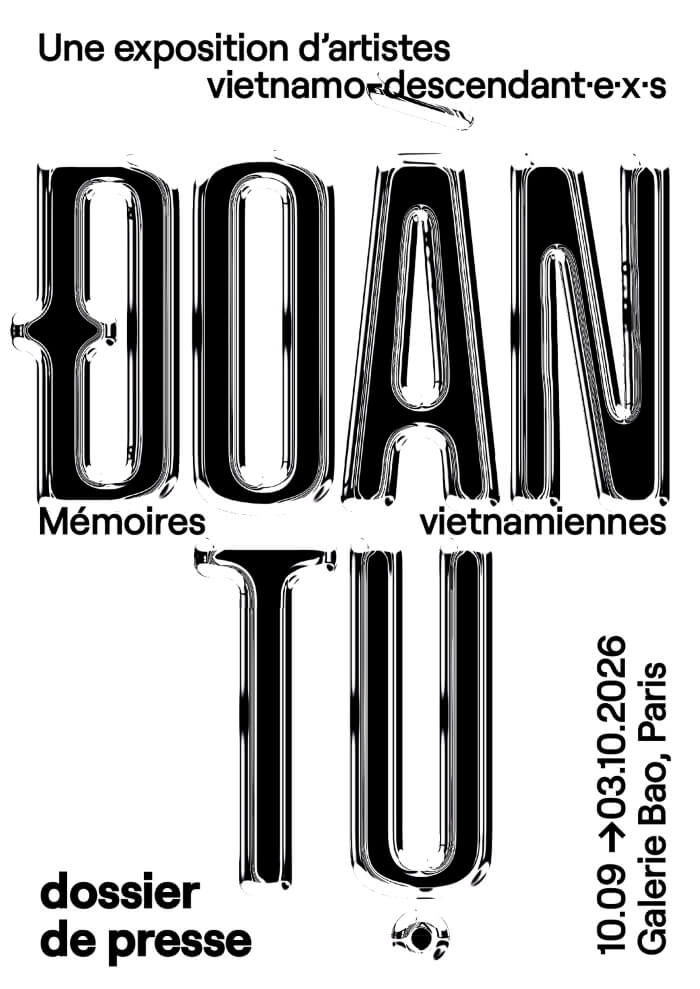
Opening: 06 PM – 09 PM, 10 Sep 2026
Exhibition: 11 AM – 07 PM, Wed – Sun, 10 Sep 2026 – 03 Oct 2026
Galerie Bao
49 Avenue Parmentier, 75011 Paris
From the organizer:
Curated by:
Eléonore Hải-Vân Trần and Camille Minh-Lan GouinFeatured and programmed artists:
Kim Đoàn Quốc, Alix Douart Sinnouretty, Louise Lan, Jo Ngô, Clément Thanh Danh Lê, Thiên Ngoc Ngô-Rioufol, Flora Nguyên, Lê Hoàng Nguyên, Matthias Pasquet, Régis Sénèque, Nicole Tran Ba Vang and Kianuë Tran Kiêu.
The third chapter of the exhibition project Đoàn Tụ, led by the collective Lune Rougissante, Vietnamese Memories brings into dialogue the memories, investigations, and imaginaries shaped around Vietnam by different generations of artists from the Vietnamese diaspora.
Sculpture, photography, drawing, video, and installation intertwine, forming together a shapeshifting history woven from echoes, multiple voices, and ghostly presences.
Vietnamese Memories, the third chapter of the exhibition project Đoàn tụ, initiated by the collective Lune rougissante, brings into dialogue memories, investigations, and imaginaries developed around Vietnam by different generations of artists from the Vietnamese diaspora in France. A scattered community, formed by the waves of exile that followed the Indochina War (1946-1954) and the subsequent American war in Vietnam (1955-1975). From CAFI[1] repatriates and FOEFI Eurasians[2] to boat people refugees and so-called economic migrants: all had their names, acronyms, and statuses defined. Upon their arrival in France, they were sometimes confined to abandoned and remote locations, and at other times dispersed throughout the country. In the late 1970s, in order to prevent the formation of diaspora enclaves, the exceptionally rapid naturalization of Vietnamese people was granted on the condition that they accept isolation. Only immediate family members were allowed to be reunited. Despite these policies of invisibilisation, memories of Vietnam took root on French soil, emerging in the form of pagodas, restaurants, and shopping centers. In these places of memory, new generations have taken shape. Born into this in-between space, they come to terms with silence and contradiction, and timidly pray to ancestors whose language they do not speak-or speak only a little-before altars filled with images that are as familiar as they are unknown. Challenging notions of origin and return, the artists featured in this exhibition navigate between Vietnam and its diasporas, probing the waters, digging into the earth and their own skin, in search of what this Vietnameseness they have inherited might be. The works they create from the elements they gather build bridges from one shore to the other, suture the fragmented parts of their being, fill the gaps in the torn fabric of collective narratives, and trace new genealogies-fictional or spectral, chosen or dreamed.
Đoàn tụ thus comes to be understood as a way of finding one another again among unfamiliar kin, connected by the same point of departure, the same origin. The multiplicity of forms and media employed by the artists constitutes as many currents feeding one and the same river. It is an act of sharing, a narrative composed in turn of each person’s perspective of Vietnam, that of their ancestors, and the one that constitutes them. Like a myriad of rays refracted through water, the works brought together form the portrait of a constantly shifting Vietnam.
Đoàn tụ is a collective movement, an exhibition that continuously forms and dissolves, carried by the currents followed by its artists and curators. After receding from Bordeaux, the wave flowed through the port of Marseille, carrying to the PAC Vietnamese stories intertwined with the colonial past of the city. In Paris, Galerie Bao welcomes a fragment of our memories, troubled waters sounded by the artists, from which stories of war and exile, misunderstood or forgotten, rise to the surface.
[1] Reception Centre for French returnees from Indochina
[2] Federation of organisations for French children of Indochina
Galerie Bao was founded from the desire to create a space for artistic practices connected to Vietnam and Southeast Asia. Đoàn Tụ marks Galerie Bao’s first programme entirely dedicated to the diasporic community, conceived as a necessary connection between these voices and the art public in Vietnam. The exhibition expands the borders of “Vietnam” beyond geography, allowing the story of a country to appear more fully through the simultaneous presence of memories carried by those who stayed, those who left, and the generations who inherited them.
Biographies
Kim Đoàn Quốc lives and works in Paris, where she is a member of DOC! and the Vietnam Dioxine Collective. Her artistic practice spans various media: installations, video and performance. Her body of work juxtaposes technology and industry with screens, and metal with natural materials such as wood and dried flowers, to explore the relationships between humans and non-humans. She frequently collaborates with other artists and scientists to explore this issue.
Kim Đoàn Quốc is particularly interested in the concept of protected spaces, both politically and ecologically. Since 2015, her work as a visual artist and performer has been exhibited internationally at institutions such as the Salon de Montrouge (Paris), Beursschouwburg (Brussels), the Centro de Cultura Digital (Mexico City), Trafo House (Budapest), the Faculty of Arts in Lisbon and the Queens Museum (New York).
Alix Douart Sinnouretty is a sound and narrative artist whose practice bridges the personal and the documentary. Her podcast “Vietnam-sur-Lot” (2023), written with Suzanne Colin and Adèle Salmon and produced by Paradiso Media, tells the story of colonization in Indochina, the lives of colonized workers, exile to France, and life at the Indochinese Repatriates Reception Center, following in the footsteps of her grandparents and her mother. She develops projects that explore transmission, memory, and identity as responses to “grand” history while paying close attention to personal narratives, particularly through her practice of hypnosis.
Her work also extends to teaching and lecturing, all of which are spaces where she explores how stories circulate, transform, shape individuals, and forge connections.
Louise Lan (b. 1993) is a visual artist living and working between Paris and Saigon. After studying literature at Sorbonne University and fine arts at the École des Beaux-Arts de Paris and the National Taiwan University of Arts in Taipei, she co-founded Nabuzardan C.C., an artist-run exhibition space located in a shopping mall in Ivry-sur-Seine, near Paris. Her work has been presented at the Musée de la Chasse et de la Nature (Paris), Centquatre-Paris, PhotoSaintGermain (Paris), the Biennale de Lyon, BEFF7 (Bangkok), GateGate Gallery (Saigon), Á Space (Hanoi), Speedy Grandma (Bangkok), Rare Sea (Saigon). She has been an artist-in-residence at Ateliers Médicis (Création en Cours and Transat), Villa Saigon (Đà Lạt), where she researched the colonization of the Vietnamese landscape through flowers introduced during the French colonial period, and Artagon Pantin (2026-2028). She received funding from the CNC for the production of her short film Rock Dragon, as well as an ADAGP research grant for a new project in Vietnam combining video, photography, and engraved mirrors.
Thiên-Ngoc Ngô-Rioufol is a Vietnamese political refugee artist based between Paris and the Ardèche. A graduate of the Bordeaux School of Fine Arts, their work encompasses drawings, installations, performances, and sculptures. It draws on personal and collective narratives from their vantage point as a queer artist of color and an antique dealer-spanning the street to the castle, the norm to the margins, and reality to fiction.
Trained in photography at the École des Gobelins, as well as at the Rodchenko School in Russia and the Ateliers des Beaux-Arts in Paris, Flora Nguyên explores representations of women and landscape since the colonial era. Her research into colonial photographic archives has taken her to the ECPAD (Établissement de Communication et de Production Audiovisuelle de la Défense), the Musée de l’Armée, the Albert Khan Museum Collection, the National Overseas Archives, and elsewhere. She examines the stereotypes that shape the collective unconscious, memory, and the transgenerational transmission of trauma. The archive is central to her practice: both a source and a subject of inquiry. She regards archival photographs as malleable materials rather than as historical evidence. By altering them, she revives forgotten stories and challenges the authority of the image as an immutable truth. Each work becomes an encounter between memory and imagination, between the material trace and its reinterpretation.
Superimposed onto painting or drawing, the archive is transformed into a more subjective work. By blending these media, Flora Nguyên seeks to open up the image to new temporalities, where memory is not fixed but constantly reinvented. Her work lies on the fragile boundary between truth and imagination, between archive and invention – a space where images continue to live, to question and to transform.
She thus conceives of the image not as a document, but as a negotiation – between memory and amnesia, truth and fiction, the gaze and resistance. Autofiction enables her to integrate her own narrative into this process of decolonisation and visual detoxification – to inhabit the archive, to rewrite it from within and to breathe new life into it.
The contemporary photography magazine *Fisheye* and *Le Nouvel Obs* have featured her in several articles, and her work has been exhibited at the Maison Européenne de la Photographie (MEP) in Paris. In 2025, Flora Nguyên will take part in prestigious international events: in September, she will exhibit in Brazil as part of the France-Brazil cultural season at Foto Rio, then in French Guiana for the Rencontres photographiques de Guyane, and in Vietnam at the Hanoi International Photo Biennale at the VCCA – Vincom Centre for Contemporary Art. She also exhibited at several venues in Vietnam (Mo Art Space, Gallery Medium), Brazil (Jardim Botânico) and France (Galerie du Montparnasse). In 2026, she was awarded a grant by the CNAP (National Centre for Visual Arts) in support of documentary photography.
Lê Hoàng Nguyên (b.1996 Đồng Hới, Viêt Nam) works across several mediums, combining industrial materials with objects that carry an intimate or historical charge to question how power structures movement across borders and produces liminal states, arranging them according to the space or commission at hand. His pieces move between the personal and the systemic, holding the point where a narrative assigned from outside meets the body that carries it.
A graduate of the Beaux-Arts de Paris (DNSAP, 2021), he is a laureate of the Prix Polyominos (2026) and of the Prix Dauphine (2025). He was a laureate of the Palais de Tokyo’s YACME program (2022) and completed a residency at Artagon Pantin (2024-2026). His work has been shown at the 68th Salon de Montrouge (2025), at La Villette as part of 100% L’EXPO (2026), at the Spiral Wacoal Art Center in Tokyo (2021), and at the Biennale de la photographie de Mulhouse (2018). His work is held in the collections of the FRAC Île-de-France and the OEC Paris.
Tèo Nguyên
Graphic Designer of the exhibition
Tèo Nguyên’s practice is informed by the visual culture in which he grew up, shaped by an abundance of forms, colours and vernacular signs. This sensitivity led him to observe and experiment with graphic practices across Southeast Asia, particularly in Vietnam, during a creative immersion in Ho Chi Minh City. His approach to graphic design is above all conceptual: each subject generates its own visual language, conceived as an accessible and sensitive space for storytelling. Typographic and chromatic experimentation play a central role, fuelled by a particular interest in vernacular and handwritten forms of writing, capable of embodying narratives, identities, tensions of meaning and dissonances. His practice has also been enriched by experiences of collective creation. Co-founding the Vif studio with Delphine Cordier, followed by the creation of the Cari-Medley illustration duo with Laho, provided spaces for exchange and experimentation that have continued to enrich and shift his personal practice.
Matthias Pasquet was born in Vannes, France, in 1989. He currently lives and works in Montreuil. After graduating in Photography from the Gobelins School in Paris, he continued his studies in a postgraduate program at the École des Beaux-Arts de Chalon-sur-Saône.
For the past ten years, his work has been presented in solo and group exhibitions. He has exhibited at the ManifestO Festival in Toulouse, the Voies Off Festival in Arles, the Incadaqués Festival in Spain, the exhibition Mutation(s) at Galerie Laurent Godin in Paris, and Past & Present at the Pinakothek der Moderne in Munich.
In 2015, his series Opération d’Archéologie Préventive received the 29th Bourse du Talent (Space category) Award and the Quinzaine Photographique Nantaise Award. His project 369 Milliards de Point won an award from the Club des Directeurs Artistiques in 2017 and was shortlisted for both the Voies Off Award and the Icart Artistik Rezo Award in 2018. His project Dynamiques des Plages received a Special Mention in the «Memories and Traditions» category of the Urbanautica Award and was a finalist for the Fisheye Prize for Visual Creation in 2023.
Visual artist.Born on December 3, 1970. Lives and works in Paris. Since 2020, Régis Sénèque has sought to expand his work into themes that explore reconstruction, precarious balance, history, conscious and unconscious memory, territories, and cultural and material values.
The path he takes-through an approach that is at once sensitive, poetic, and socially engaged-is deeply marked by the ever-present “living past.” This transgenerational memory, embedded in our DNA on both individual and collective levels, serves as the lens through which he seeks to understand the world. Whether through drawing, installation, photography, or performance, his working methods-as well as the resulting works- are conceived as “rituals,” chimeras that may, in a small way, heal the past and reconstruct the present.
Régis Sénèque is represented by Galerie Marguerite Milin in Paris; he has recently presented or participated in several major exhibitions: *L’or des fous* and *Pour tout l’or du monde* at Galerie Marguerite Milin (Paris), *Le genre idéal* at the MAC VAL museum (Vitry-sur-Seine), *Passé vivant* at Atelier Martel (Paris), as well as the Festival du dessin, as part of *Les enfants d’Arles exposent* (Arles). In 2023, curated the group exhibition *Faire corps* at Galerie Marguerite Milin, bringing together artists, architects, and authors.
Today, a selection of his works has been added to the collections of the MacVal, the Val-de-Marne Museum of Contemporary Art.
Nicole Tran Ba Vang lives and works in Paris. Since the late 1990s, she has explored the relationships between the body, surface, identity and memory through photography, video, painting, textiles and installation. Her current practice focuses on family memory, non-verbal transmission and the legacies of French colonial history in Vietnam. Working with food-based materials such as rice paper and rice vermicelli, she creates works in which food becomes both a support for memory and a sensitive archive.
Her work has been shown in institutions across France and internationally, including the Maison Européenne de la Photographie (MEP, Paris), the CCC OD – Centre de Création Contemporaine Olivier Debré (Tours), and the Tokyo Metropolitan Museum.
Her work is held in public and private collections, including the Musée d’Art Moderne et Contemporain de Saint-Étienne Métropole (MAMC+), the Bibliothèque nationale de France (BnF), the Maison Européenne de la Photographie (MEP), Neuflize Vie / ABN AMRO, the Neue Galerie am Landesmuseum Joanneum (Graz), the Frederick R. Weisman Art Foundation (USA), and the Fondation Louis Vuitton.
Kianuë Tran Kiêu is a solarpunk asiofuturist artist whose work explores the concept of refuge as a space for regeneration, resistance, and repair. Their ritual practice, informed by đồng cô trances, áp vong invocations, and the agricultural and animist cosmologies of Vietnam, intertwines natural emotions with the traumatic memories of diasporas. They create sensitive clearings, traversed by unruly spiritualities, where repressed pains transform into political seeds and queer acts of care. Their art is a song for the margins, a gesture of fertile disobedience. Recipient of the 2023 Utopi·e Prize, their work has been exhibited at La Villette, the 67th Salon de Montrouge, and internationally across various exhibition contexts. In 2025, Siffler La Nuit was acquired by the Musée des Abattoirs – FRAC Occitanie for its permanent collection.
Programmation
Jo (Ngô Kỳ Duyên) is a Saigonese multi-disciplinary artist working across new media art. Her practice bridges painting, tattoo art, and electronic art therapy, blending mythical and dreamlike elements to explore healing, inner transformation, and emotional resilience. Rooted in a vision of art as a safe and sacred space, Jo creates works that serve as mental sanctuaries-especially vital in a post-pandemic world. Through surreal narratives and sensory-rich experiences, she invites audiences to reconnect with their imagination and inner peace. Now, she resides in a rural house with a big garden and 7 dogs.
Clément Thanh Danh Lê, born in 2001 and a graduate of the Fine Arts Institute of Marseille and the Fine Arts Institute of Bordeaux, lives and works in Paris. His work sits at the crossroads of several disciplines: writing, image, installation, and performance. By exploring the silence surrounding narratives of displacement and exile, he draws on recovered fragments of reality, motifs, and gestures, reinterpreting them. The word, which he uses as a material, becomes a means of questioning language, notably by confronting the credibility of academic discourse with that of R’n’B culture, and more specifically rap, within the contemporary literary landscape. His work interrogates the value of various forms of expression and their place in current cultural discourse.
Exhibition curators
Eléonore Hải Vân Tran is a PhD candidate in contemporary art history at Paris 8 University. Through the analysis of works by contemporary artists of Vietnamese origin, her research examines photography as a material through which family histories can be (re)constructed, and as a medium for forging new narratives of the self and the community.
She has written for several contemporary art spaces in Vietnam, including the Vincom Center for Contemporary Art and Mơ Art Space. She has also presented her research at conferences and public events on the practice and uses of photography within the Vietnamese diaspora in France (Institut National d’Histoire de l’Art, Sciences Po Paris, Galerie Bao) and in Vietnam (Fulbright University Vietnam, Sàn Art, Photo Hanoi ’23).
Her writing on photography as a means of understanding and reconstructing the experience of exile has been published in Trans Asia Photography (Duke University Press) and in the creative criticism journal Outsider.
Camille Minh-Lan Gouin is a curator, art critic, independent researcher, and cultural educator. Influenced by the social sciences, she explores the fantasies of neoliberal media societies and the settings in which these fictions unfold, describing the world not as it is but as it is imagined.
She recently served as associate curator of the exhibition “Berserk and Pyrrhia: Contemporary Art and Medieval Art,” presented at the FRAC Île-de-France in Paris and Romainville. In addition to her curatorial and writing activities, she co-founded the association VIRAGES, which aims to support artists as they enter the workforce through a mentoring program called “En Tandem.”