Heirloom
16 Sep – 20 Nov 2026
Vin Gallery
35/8 Nguyễn Văn Đậu, Bình Lợi Trung, TP.HCM
From the organizer:
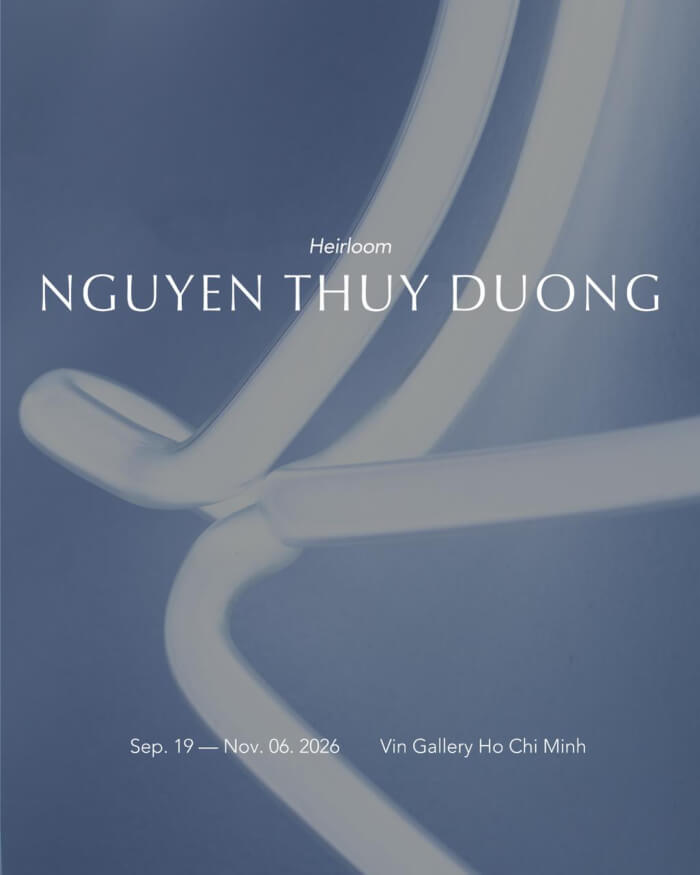
Working across sculpture, moving image and installation, Vietnamese artist Duong Thuy Nguyen presents Heirloom, her first solo exhibition, opening at Vin Gallery, Ho Chi Minh City, from 16 September to 20 November 2026.
Developed through research and material experimentation, Heirloom examines the enduring afterlives of Agent Orange, known in Vietnam as chất độc màu da cam.
Bringing together newly commissioned artworks with military maps, declassified documents, archival film and oral histories, the exhibition considers how histories of chemical warfare continue to shape landscapes, bodies and cultural memory decades after the Vietnam War.
Rather than treating the archive as a historical record to be illustrated, Nguyen approaches it as a material to be worked through. Developed through research at the Sam Johnson Vietnam Archive at Texas Tech University, Heirloom explores fragments, absences and material traces, asking how memory is inherited, transformed and carried across generations.
Born in Hà Nội, Nguyen’s interdisciplinary practice investigates the intersections of environmental change, cultural memory and material transformation. Her work combines archival research with sculptural processes to explore how histories persist beyond official documentation, remaining embedded within landscapes, objects and the body.
At the centre of the exhibition is Songs for the Unremembered, a newly commissioned moving-image work that imagines the journey of Agent Orange – from its manufacture and transportation in striped barrels to its dispersal across Vietnam’s forests and its enduring presence within ecological and human systems.
Blending documentary research with speculative storytelling, the work reflects on the invisible and ongoing consequences of chemical warfare while questioning how histories are remembered, forgotten and retold.
Rather than reconstructing the past, Heirloom proposes memory as something living: continually carried, transformed and inherited. Through sculpture, moving image and installation, the exhibition asks what remains after conflict, and how contemporary art might make visible histories that continue to unfold long after they disappear from public attention.
Duong Thuy Nguyen said:
“Heirloom began with a question about what it means to inherit a history that happened before you, but continues to live through bodies, landscapes and family memory. Through my research into Agent Orange, I became interested not only in what the archive records, but also in what it cannot hold: the absences, fragments and forms of memory that are carried across generations. The exhibition is my way of staying with those traces, rather than trying to resolve them.”
Speaking about Songs for the Unremembered, Gioj De Marco, co-founder and co-director of Prospect Art said: “The work is moving and unnerving; powerful in its subtle ghastly connectivity – your ghosts, my ghosts, all the ghosts of all the wars that indeed, we’ve inherited subconsciously. We will be sitting with these thoughts for a while.”
Vin gallery: “Presenting these materials in Vietnam requires close attention to historical specificity and to the uneven ways their consequences are lived. Vin Gallery has approached the exhibition on those terms. Injury is not made into spectacle, and archival visibility is not mistaken for resolution. What the exhibition establishes is not the recovery of a closed past, but a way of approaching one that remains active in the present.
Heirloom reflects Vin Gallery’s commitment to practices in which research does not sit outside the work as explanation; it participates in the work’s form. The exhibition brings into focus Nguyen’s recent engagement with archives, material, and moving image. Its title also loses its familiar warmth: what is passed on is not a cherished object, but a material legacy no one chose to inherit.”
About Vin Gallery
Since its founding in 2012 in Ho Chi Minh City, Vietnam, Vin Gallery has been committed to building a contemporary art platform that reaches beyond geographical and cultural boundaries, exploring how artistic practices take shape and evolve in a post-globalisation context.
As a key connector between Southeast Asia and the global art ecosystem, Vin Gallery develops a decentralised artistic network through a distinct curatorial approach. Representing artists from diverse cultural backgrounds, the gallery actively reconsiders the linear narrative of traditional art history and focuses on practices formed within cultural intersections and cross-cultural experiences—works that often show strong vitality and experimentation as they move beyond established frameworks.