
The Vietnam–Japan lacquer road project · notes from Wajima
Hanoi – Wajima Lacquer Journey
Four Days in Wajima, Where a 600-Year-Old Craft is Rebuilding Itself After the Earthquake
From September 29 to October 2, 2026, three Vietnamese artists—Đinh Công Đạt, Trương Hoàng Hải, and Trần Thảo Miên—visited Wajima city on the Noto Peninsula for the first component of the Vietnam–Japan Lacquer Road Project, jointly implemented by Hanoi Grapevine and TAKI Corporation. Over four days, they visited numerous stops: from craft association halls, museums, and training academies, to workshops specializing in wooden bases (kiji), cloth wrapping (nunokise), maki-e painting, and roiro polishing. This is a record of what one lacquer community can learn from another—when both are faced with the question of how to sustain the lacquer craft sustainably.
The Road Begins with Tremors
In early 2024, a powerful 7.6-magnitude earthquake shook the Noto Peninsula, Ishikawa Prefecture. In Wajima, the earthquake triggered fires that burned down over 50,000 square meters of the famous morning market, collapsed workshops, and buried tools. Nine months later, a major flood swept through areas that had just been cleared. For a craft where each item passes through the hands of dozens of specialized artisans working in small workshops scattered across the city, losing a workshop is not just losing a space: it is a broken link in an entire chain.
Nearly three years later, when the Vietnamese delegation set foot in Wajima in late September 2026, the cracks were still visible—on the pavements, temple roofs, and coastal rock formations that had abruptly risen above the water. But things were also being rebuilt. It is precisely these things being rebuilt that inspired this trip.
In July 2026, Hanoi Grapevine and TAKI Corporation (Tokyo) officially launched the Vietnam–Japan Lacquer Road Project, aiming to build a long-term cooperation platform between Vietnamese lacquer art and Wajima-nuri—widely regarded as the benchmark of Japanese lacquer. According to Mr. Uchiyama Ken, Managing Director in charge of IDEAL Company at TAKI Corporation, this is the company’s first official cultural exchange framework with a foreign partner, and he hopes the dialogue between the two lacquer traditions will become a “road” carrying techniques and aesthetics to future generations.
The project does not stop at placing two heritages side by side for comparison. Envisioned components include artisan-artist exchanges, artist-in-residence programs at workshops, collaborative creations, mobile exhibitions between Hanoi and Japan, academic research, youth training, archiving and publishing, and connecting with Wajima’s post-disaster recovery efforts. The September research trip is the first step: three art practitioners from Vietnam, each with a different approach to lacquer, traveled to see, hear, and touch an ecosystem of craftsmanship operating very differently from home.
Truong Hoang Hai participated as an artist from the De.lac group, as well as a researcher in lacquer production and experimentation. Dinh Cong Dat is a sculptor working with lacquer materials. Tran Thao Mien is a visual artist and co-founder of Collective SŌNSŌN—a collective operating at the intersection of traditional Vietnamese handicraft and contemporary design. Three people, three ways of questioning the same material.
The Road to Noto
On the morning of September 29, the flight from Haneda landed at Noto Satoyama Airport in less than an hour. From there, the delegation drove to the northern part of the peninsula. Noto juts out into the Sea of Japan like a finger, with mountainous terrain, sparse population, and distance—far enough to explain why Wajima once had to fend for itself to transport its products across the country.
To understand what the delegation encountered over four days, it is necessary to step back and view Wajima-nuri as a history—not only of techniques, but of a craft economy.
From Zen Temples to the Dining Table
The spread of Wajima lacquer is closely tied to Sōji-ji, a Soto Zen temple established in Monzen in the southwestern part of the city in the early 14th century. For centuries, this was one of the two main headquarters of the sect, attracting monks from all over. Lacquerware used in the temple—rice bowls, trays, ritual objects—followed monks and pilgrims out of the peninsula. The oldest surviving antique Wajima lacquer artifact is believed to be the red-lacquered temple door at Juuzou Shrine, dating back to the early 16th century.
Jinoko: The Secret Rests in the Earth
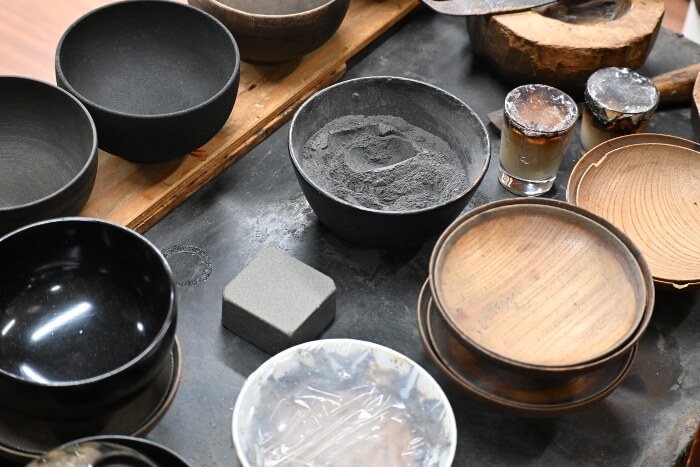
What defines Wajima’s technical identity is jinoko—diatomite powder with a characteristic black color, locally quarried, fired and finely ground, then mixed with raw lacquer to create primer layers. This primer gives Wajima lacquerware its renowned durability, enabling it to withstand impacts and generations of daily use. This technique crystallized around the Edo period, along with nunokise—wrapping hemp cloth over vulnerable wooden base joints like bowl rims and bases.
This creates an intriguing point of connection with Vietnamese lacquer makers. In traditional Vietnamese lacquer groundwork (vóc), artisans also wrap cloth around wooden cores and apply hom—a mixture of raw lacquer with sawdust or alluvial soil—to create a foundation. Two traditions, thousands of kilometers apart, arrived at the same solution to the same problem: wood shrinks and warps, lacquer is brittle, and something must be placed in between to keep things from cracking.
Traveling Lacquer Merchants Across the Country
A craft in a remote location like Wajima could only thrive thanks to a special distribution system. Since the Edo period, nushiya—lacquer workshop owners who act as both production organizers and merchants—personally carried goods across regions, selling them on installment plans and taking direct orders from families, temples, and restaurants. Trading ships along the Sea of Japan coast, known as kitamaebune, also helped transport Wajima lacquer far and wide. Consequently, Wajima lacquerware was not merely a luxury item displayed in glass cabinets, but utilitarian objects for major life milestones: weddings, death anniversaries, and festivals. Also during the Edo period, decorative techniques flourished: chinkin—carving patterns into the lacquer surface and filling the grooves with gold leaf—and maki-e—painting with lacquer and sprinkling gold or silver powder while the lacquer is still wet. From a utilitarian craft focused on durability, Wajima-nuri gradually evolved into a sophisticated decorative art.
Over a Hundred Stages, Dozens of Pairs of Hands
Perhaps the most distinctive feature of Wajima lies not in a single technique, but in its labor organization. A Wajima-nuriitem goes through more than a hundred stages, and each group of stages belongs to a specialized craft: wooden base makers (kijishi)—whose craft is further subdivided by base type: bowl turning, box assembly, thin wood bending, complex block carving; primer and mid-coat painters; polishers; top-coat painters; roiro polishers; maki-e painters; and chinkin carvers. The nushiya stands in the middle, coordinating the entire chain.
This specialization yields exceptionally high craftsmanship and stable productivity. However, it also makes the system vulnerable: when one stage lacks hands, the entire chain slows down. In 1977, Wajima-nuri techniques were recognized as an Important Intangible Cultural Property of Japan. By the early 1990s, Wajima’s lacquer industry peaked in sales, then declined alongside lifestyle changes when ceremonial lacquer tableware ceased to be essential in every household. The number of craftspeople gradually decreased. According to AFP, prior to the 2024 disaster, this network still comprised about 700 artisans and workers—and that very network was shattered by the earthquake.
Day One: Understanding the Craft from Structure to Infrastructure
On the afternoon of September 29, the delegation’s first official stop was the Wajima Lacquerware Associationand Hall (Wajima-nuri Kaikan). Here, the group received an overview of the industry and visited the lacquer processing workshop—where raw lacquer sap is filtered, stirred, and dehydrated to produce refined lacquer for each specific stage. For Vietnamese artists accustomed to local lacquer (sơn ta) extracted from Phú Thọ trees, this was a moment to clearly observe material differences: Japanese urushi and Vietnamese sơn ta derive from two related yet different tree species, dry in different ways, and require distinct handling. Sơn ta is renowned for its gloss and transparency revealing underlying layers; urushi is famous for its durability and deep blackness upon polishing.
The meeting at the Hall was also the first time the three Vietnamese artists introduced their practices to their Wajima peers. Although time was limited, it sufficed to lay the groundwork for something vital: this encounter would always be two-way. The Vietnamese came not only to learn, but also carrying a lacquer tradition with its own history, language, and questions.
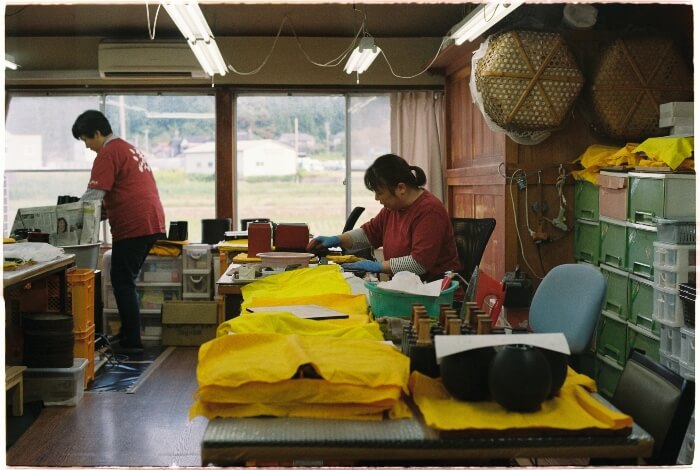
Following this, the delegation visited the Shioyasu lacquer workshop, a nushiya, and continued presentations. Meeting a nushiya on day one was a deliberate choice: this position offers the clearest panorama of the trade. The nushiya knows every wooden base maker, polisher, and painter in their network; knows which item awaits at which step; and knows what customers need. While a lacquer workshop in Vietnam typically consolidates multiple stages under one roof, in Wajima, the “workshop” is an entire city. For Truong Hoang Hai, this was a precious networking opportunity, as he is directly involved in developing packaging for Vietnamese lacquer to reach international markets.
Day Two: Institutions That “Preserve” the Craft
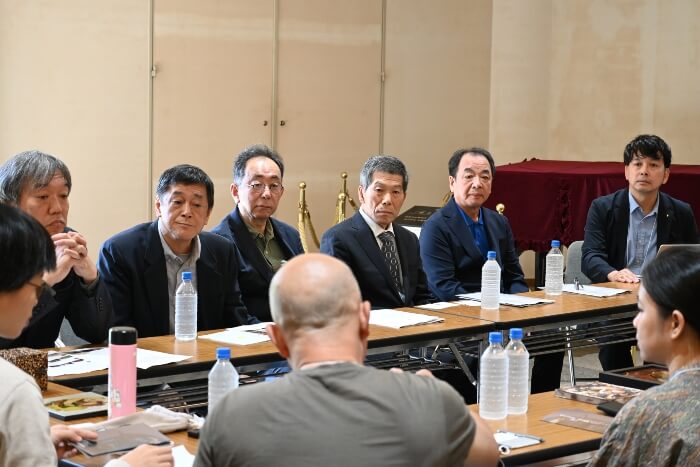
September 30 began at the Wajima Museum of Art with a lecture in the auditorium, followed by a meeting with the Wajima Lacquerware Technical Preservation Association—an organization of practitioners recognized as holding important intangible cultural properties. Five artisans were present, alongside the city’s Mayor. The local government’s presence demonstrated that in Wajima, lacquer is not merely a matter for craftspeople: it is identity and part of urban recovery planning.
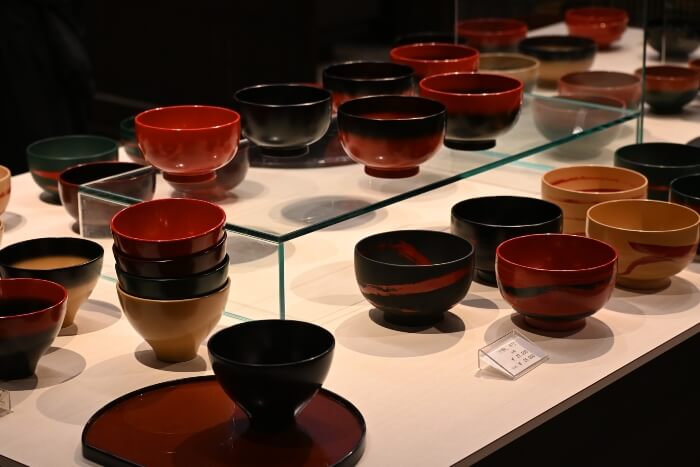
After the meeting, the delegation toured the museum, which was hosting an exhibition on Asian lacquer. Placing Wajima-nuri alongside other regional lacquer traditions—including Vietnam—served as a reminder that lacquer has never been the exclusive heritage of a single nation. The lacquer road, literally, existed long before this project: lacquer sap, techniques, and artisans have traveled across Asian lands for centuries.
“Earth at Night”: One Globe, Eight Crafts
At the museum, the delegation lingered long before the Wajima lacquer globe “Earth at Night”, measuring about one meter in diameter. Its surface is deep pitch black, upon which the world’s cities emerge as tiny golden dots of light, as if viewing the Earth from space at midnight. Surrounding the globe are four maki-e panels depicting night scenes of Tokyo, Beijing, London, and New York, executed primarily in gold and platinum.
The globe’s story is also the craft’s story. The Wajima Lacquerware Technical Preservation Association, recognized since 1977, divides the craft into eight specialized fields: wan-kiji (bowl turning), magemono (wood bending), sashimono (nail-less box/cabinet joinery), hou-kiji (complex block carving), kyūshitsu (lacquering), roiro (polishing), maki-e, and chinkin. The globe was conceived as a five-year joint project mobilizing all eight crafts. The reference model was an antique globe from Takeo city (Saga Prefecture), an important cultural property. The Preservation Association insisted that the work be entirely crafted within Wajima. Even the most skilled artisans had never previously made a one-meter-diameter Wajima-nuri sphere.
Standing before the globe, the delegation saw virtually everything they would encounter in subsequent days—from wooden bases and cloth wrapping to maki-e and roiro—packaged into a single object. Yet more compelling was the spirit behind it. According to the museum’s introduction, the creators hoped it would transmit, from a small corner of Wajima to the world, the significance of thinking of others above conflict and division. Less than two years after the globe’s completion, Wajima itself became the place needing the world’s care.
The Training Institute: How the Craft is Taught
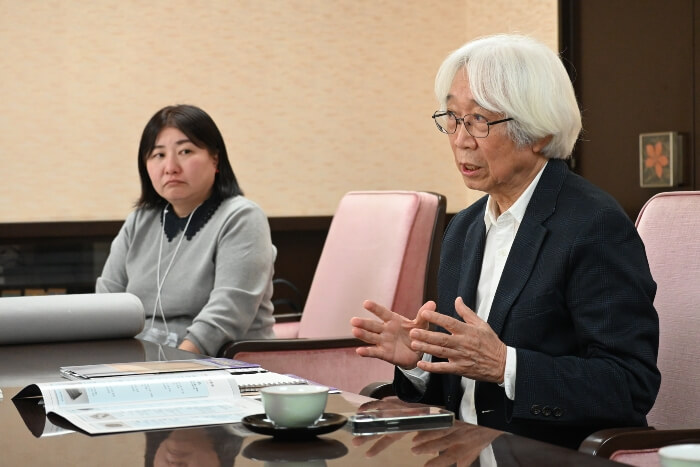
In the afternoon, the delegation visited the Ishikawa Prefectural Wajima Lacquerware Technical Training Institute—which trains successive generations of craftspeople through long-term programs guided directly by top artisans. The delegation toured the facilities, visited classrooms, and received remarks from Director Komori. Artisan Komori Kunie, recognized as a Living National Treasure in kyūshitsu (lacquering) techniques since 2006, is one of Wajima’s three Living National Treasures whose works featured in the The Spirit of Noto exhibition in New York in 2024.
For a project aiming to train youth, this visit served as a crucial reference point. In Vietnam, lacquer is taught primarily as a painting medium in art schools, ever since painters of the Indochina Fine Arts College era transformed local lacquer into a pictorial language. In Wajima, lacquer is taught as a trade—with years spent practicing a single motion until the hands intuitively know it. These two models do not exclude each other, and each likely lacks a part of the other.
Wooden Bases: Where Everything Begins
The final part of the day was dedicated to kiji—wooden bases. The delegation visited Aizawa Mokuzai Kogei to meet Mr. Aizawa, then Tsuji’s wooden base workshop to meet Mr. Tsuji. In the Wajima production chain, the wooden base maker stands at the very beginning and is the most easily forgotten stage: nobody sees the wooden base once the item is finished, yet every lacquer layer above depends on it. Wood must be correctly chosen, seasoned for years, and cut along the right grain to prevent warping after donning dozens of layers of lacquer. Mr. Tsuji and his wife even plant lacquer trees in their courtyard to experiment with new lacquer layers themselves.
For Dinh Cong Dat, who approaches lacquer from sculpture, the wooden base stage is where questions of form and structure manifest most clearly. For the entire project, dedicating an entire afternoon to base makers served as a subtle declaration: heritage resides not merely in the glittering gold layer on the surface, but across all the anonymous hands beneath.
Day Three: Learning Through the Hands
If day two was the day of institutions, October 1 was the day of hands. The delegation visited five workshops, three of which offered hands-on experiences.
Cloth Wrapping – Tohachiya
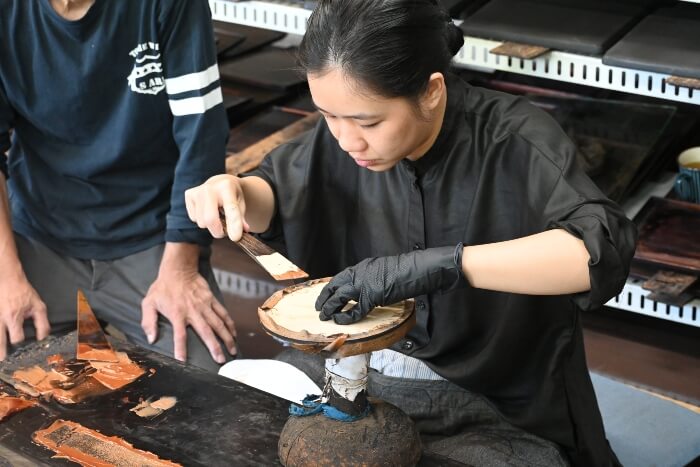
The first stop was Tohachiya, where Mr. Shioji introduced and guided the nunokise technique—wrapping hemp cloth onto wooden bases. He currently manages his family business. Throughout the four days, he also accompanied the delegation, alongside Ms. Mayu Urade—a young designer and daughter of lacquer artisan Urade Katsuhiko—both of whom support the craft association’s work. Being guided into one’s workshop by a young successor inheriting a family enterprise is an experience entirely distinct from listening to museum presentations.
Nunokise is one of the processes ensuring Wajima-nuri’s durability, and shares the closest affinity with Vietnam’s bóc vócprocess. Direct execution, rather than mere observation, is the fastest way to recognize subtle differences: fabric type, tension, lacquer adhesive type, and edge treatment.
Chinkin – At Artisan Maeda Yasutaka’s Home
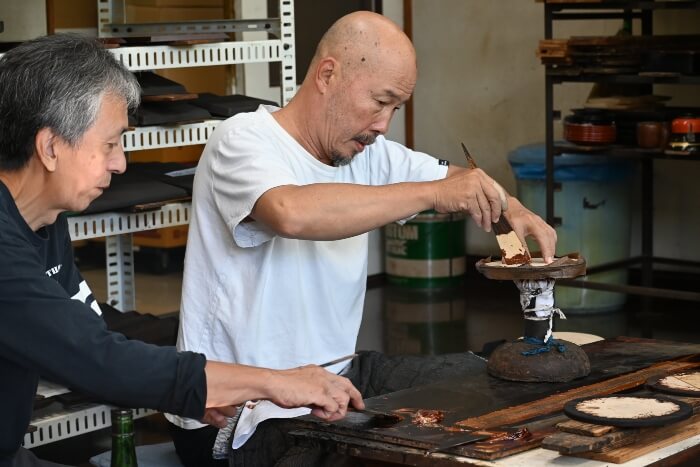
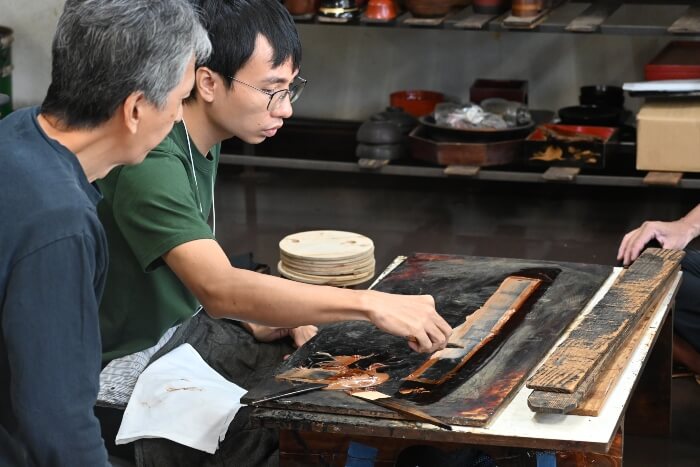
The exploration of chinkin took place directly at the home and workshop of chinkin artisan Maeda Yasutaka. Among all Japanese lacquer regions, Wajima is the sole place preserving chinkin techniques. Mr. Maeda has held solo exhibitions in Singapore, the USA, and Malta. The artists held knives to practice carving a few lines. Just a little, yet enough to feel the resistance of the hardened lacquer surface, and to understand why in chinkin, every carved stroke is an irreversible decision. For Vietnamese lacquer practitioners, chinkin evokes carving techniques on lacquer panels but operates on a different logic. In Vietnam, carved lines typically reveal underlying color layers or create tactile texture for the artwork’s surface. In Wajima, the carved line is a mold holding the luminescence of gold. The same blade on a lacquer surface opens depth on one side, while forging light on the other. A technique surviving in a small coastal Japanese town: the story of chinkin offers further proof that Asian lacquer has always been a pathway traversing multiple regions.
Maki-e – Hokusai on Lacquer Surfaces, at Teranishi Shōta’s Workshop
In the afternoon, the delegation visited artisan Teranishi Shōta’s workshop to experience maki-e. Mr. Teranishi is among fourteen Wajima lacquer artisans featured in the exhibition The Spirit of Noto: Urushi Artists of Wajima at Onishi Gallery, New York (October 2024). Organized to support the Noto artisan community post-earthquake, his works displayed there—carefully brought out for the artists to admire—demonstrate how Wajima maki-e can be simultaneously classical and deeply poetic.
The practical session featured a deliberate thematic choice. Artists painted with lacquer and maki-e powder over two classic woodblock prints from Katsushika Hokusai’s series Thirty-Six Views of Mount Fuji (Fugaku Sanjūrokkei). Universally familiar compositions were translated into another medium. Color was no longer printing ink absorbed into paper, but layers of lacquer and metallic powder resting on a black lacquer ground.
This choice also shared a beautiful coincidence. Hokusai’s series, created in the early 1830s, was likewise the product of a division-of-labor system closely resembling Wajima: the artist designed the pattern, the carver cut the blocks, the printer printed the images, and the publisher coordinated the chain. Much like lacquer, ukiyo-e was once an item of daily life before becoming “art” in museums. Placing Hokusai on a Wajima lacquer surface brought two heritages of the same craft culture into dialogue, and the three Vietnamese artists entered that dialogue with their own hands.
Maki-e is also where Vietnamese observers most easily find common ground, yet also spot differences. Vietnamese lacquer paintings likewise use gold, silver, eggshells, and mother-of-pearl, yet these are embedded into lacquer layers and ground down to create depth as if viewed through water. Wajima’s maki-e sprinkles metallic powder onto wet lacquer lines, with each particle size yielding a distinct hue. These represent two differing philosophies of light: one lets light emerge from beneath, while the other places light upon the surface.
Wajima Kirimoto – A Workshop Thinking of the Future
Mid-morning, the delegation spent the longest block of the day at Wajima Kirimoto, where Mr. Kirimoto provided an overview of the workshop. Hailing from a multi-generational family of wooden base makers, Kirimoto is known as one of the most proactive entities integrating Wajima lacquer into contemporary living: collaborating with designers, developing products for modern living spaces, and post-earthquake, striving to reconnect the network of artisans. For a project seeking contemporary directions for handicrafts, this is a valuable reference model—especially for Tran Thao Mien, who alongside Collective SŌNSŌN engages in precisely connecting traditional craft with design.
Roiro – Where Black Becomes a Mirror
The final stop of the day was the home of Mr. Masui, a roiro artisan. Roiro is the final polishing stage: following the topcoat, the surface is ground with charcoal, then hand-polished with oil and fine powder, repeated multiple times until the black is deep enough to reflect one’s reflection. In his message for the New York exhibition, artisan Yamagishi Kazuo—another Living National Treasure of Wajima—stated that no black surpasses the black of urushi. For Vietnamese practitioners, this stage carries special significance: the word “mài” (to grind/polish) is embedded right in the Vietnamese name for lacquer (sơn mài). In Vietnam, grinding is meant to unveil—grinding through layers to let images emerge. In Wajima, grinding is meant to enclose—making the surface an absolute plane devoid of handprints. The same physical action, two philosophies. Coincidentally, right before the earthquake, artisan Masui had decided to pivot from roiro polishing to making small spherical sample products with diverse functions and flexible applications. Thus, even when relocating to a much smaller apartment, he could still move between rooms to work daily.
Day Four: Dialogue and Reflection
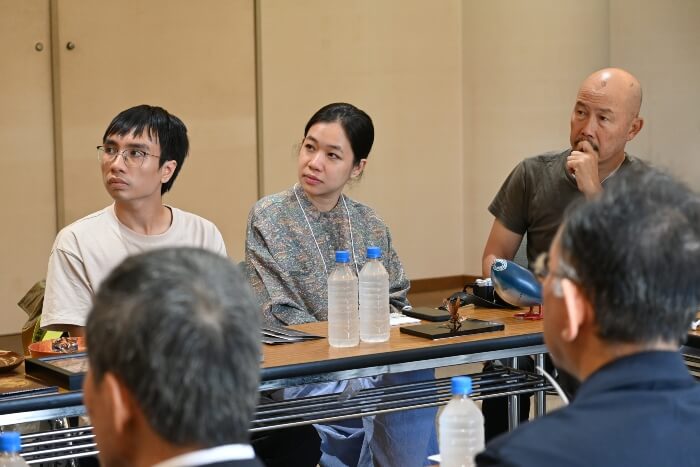
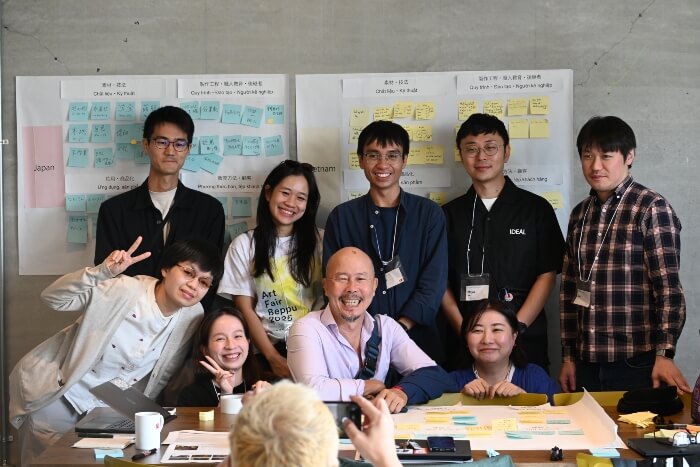
On the morning of October 2, the delegation held an interactive workshop at the café of Wajima City Hall. After three days of observing and listening, this was when the conversation was placed on equal footing: no longer visitors and hosts, but craftspeople sitting at the same table. That the meeting occurred at City Hall—rather than either party’s workshop—also carried meaning: this was a shared space where the story of lacquer intertwined with the story of the city.
Following this, the delegation was introduced to a project led by Yasujima Yukiharu’s group (Toyama University). This is a volunteer activity finding and rescuing Wajima lacquer items buried in mud and debris following the 2024 Noto Peninsula earthquake, then cleaning and restoring them. Thanks to jinoko primer layers, many items remained intact beneath the mud. Rescuing a lacquered item is also rescuing a piece of family memory associated with its use, serving as silent testimony to the durability this craft has pursued for centuries. The artists retained cherished memories while continuously posing questions for their subsequent journey.
The question of chains: Wajima’s strength lies in its deep specialization network, which is simultaneously its vulnerability. Vietnamese lacquer, conversely, typically concentrates multiple stages within a single workshop or artist. Is there anything Vietnamese practitioners can learn from how Wajima organizes craft knowledge into a system—and what can Wajima learn from the flexibility of the Vietnamese model when craft labor shortages become a shared issue?
The question of craft transmission: Wajima features a Training Institute, a Preservation Association, and state-recognized/supported artisans. Vietnam has art schools teaching lacquer as a pictorial language, alongside craft villages where knowledge passes through families. Both face generational fractures. Dialogue between the two models could spark a joint training curriculum, as envisioned by the project.
The question of contemporary relevance: Workshops like Kirimoto, artisans like Teranishi or Urade, show that Wajima-nuri is not frozen in the past. Vietnamese lacquer has likewise renewed itself repeatedly, from Indochina-era lacquer paintings to today’s installation, sculpture, and design practices. When these two streams converge, the most intriguing aspect is likely not which side learns from the other, but what unprecedented creations might emerge at the intersection.
These questions will be presented to the public as early as November 2026, when the project participates in the Hanoi Creative Design Festival 2026.
There is a peculiar truth about lacquer recognized by practitioners in both countries: lacquer does not dry by sunshine and wind. It dries in curing chambers, in humidity, in darkness, slowly, layer by layer. Rush it, and it cracks. Keep it too dry, and it never hardens. A cooperative relationship is no different. Four days in Wajima represent the first primer layer—the unseen layer upon work completion, yet upon which everything above relies. Subsequent layers will require time, repeated encounters, and mutual patience. And a touch of humidity—of trust, curiosity, and the belief that an ancient craft can still have a future.
About the Project
The Vietnam–Japan Lacquer Road Project is a long-term collaboration between Hanoi Grapevine and TAKI Corporation (Tokyo), launched in July 2026. Hanoi Grapevine serves as the Vietnamese coordinator. Component 1—the research program in Wajima—took place from September 28 to October 4, 2026, with the participation of Truong Hoang Hai, Dinh Cong Dat, and Tran Thao Mien. Component 2 will unfold within the framework of the Hanoi Creative Design Festival 2026 (November 2026).