In Plain Sight
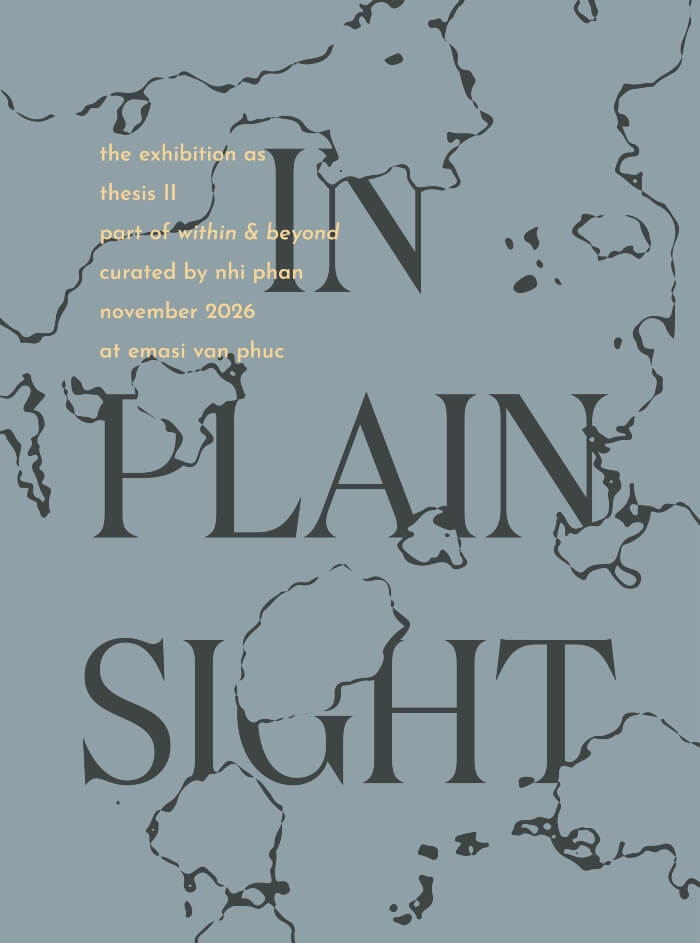
10 AM – 04 PM, Nov 2026
EMASI Van Phuc Campus
2 Street No. 5, Van Phuc Urban Area, Hiep Binh Ward, HCMC
From the organizer:
Nguyễn Art Foundation (NAF) proudly presents ‘In Plain Sight’, a group exhibition featuring artists Do Hoang Tuong, Tran Trung Tin, Hoang Ngoc Tu, Nguyen Le Tuan Kiet, Quynh Dong, Dao Tung, Nguyen Van Cuong, Tran Trong Vu, and Phan Thao Nguyen, curated by Nhi Phan.
‘In Plain Sight’ opens onto a landscape where everything is already laid bare – objects, people, and events alike. A collapse unfolds as familiar structures, values, and meanings are dismantled before our eyes. Yet, even as things disappear in plain sight, much remains beyond our grasp.
Moving between bodies, objects, and acts of looking, the exhibition-as-thesis traces the ways in which disappearance is witnessed, registered, and felt. Bodies absorb the dissonance of their surroundings; displaced objects carry the weight of lives and longings left behind; and the gaze turns upon itself, questioning what we are made to see and what we have learned to overlook. Through these encounters, the exhibition draws our attention towards the intangible that seeps through what is visibly present: the vague, the unnamed, and the sentiments that resist easy articulation.
Here, the comfortable distance of an onlooker begins to falter. To acknowledge what sits in plain sight – to witness – is thus to accept a state of mutual exposure, for what we look at and where we stand are always bound together. Pushing past surface appearances, the exhibition asks us to stay with the unmendable fractures, let ourselves be undone by what we think we know, and attest to what is present amid uncertainty.
About artists
Do Hoang Tuong
Do Hoang Tuong (b. 1960, Vietnam) graduated from the Ho Chi Minh City University of Fine Arts in 1984, and belongs to an influential generation of abstract painters in the South of Vietnam in the 1990s, namely the Group of 10. Since 2000, he returned to figurative painting, showing the desire for the founding of a new artistic path: to repair the violent loss and destruction of our human condition. Hoang Tuong’s signature figures are often stretched or contorted in torment, their legs in sexualized pose with bodies in disproportion, as if to provoke a sense of danger and anger. For him, making art helps one depart from the trauma of history.
Select notable exhibitions include S.E.A Focus, Gillman Barracks, Singapore, 2019; Art Expo Malaysia Plus, MATRADE Exhibition and Convention Centre (MECC), Kuala Lumpur, Malaysia, 2018; Ties of History: Art in Southeast Asia, the Metropolitan Museum of Manila, the Yuchengco Museum, and the University of the Philippines Vargas Museum, Manila, Philippines, 2018; ART STAGE Singapore, Marina Bay Sands Expo & Convention Centre, Singapore, 2018; Personal Structures, European Cultural Center and GAA Foundation, Venice, Italy, 2017; Open Door – Fine Arts during the 30 years after Doi Moi, Vietnam Fine Art Museum, Hanoi, Vietnam, 2016; Eagles Fly, Sheep Flock: Biographical Imprints, Artistic Practices in Southeast Asia, Singapore, 2015.
Tran Trung Tin
Tran Trung Tin (1933–2008, Vietnam) was born in Ben Tre and joined the Resistance against the French when he was 12 years old. In 1954, he was mobilized to Hanoi and admitted to the Vietnam Academy of Theater and Cinema where he worked as an actor and a screenwriter for propaganda films. In 1969, he started drawing and became known as a self-taught artist. In 1975, he moved to Ho Chi Minh City where he continued to work and lived until his death in 2008.
Tran Trung Tin’s notable exhibitions include Birdsong, Manzi Exhibition Space, Hanoi, Vietnam, 2023; Optimistic Tragedy, Vietnam Fine Arts Museum, Hanoi, Vietnam, 2013; More Than 100 Times Admiring Tran Trung Tin, Blue Space, HCMC, 1998; Painting and Sculpture Exhibition, Gallery of the Artists Association, HCMC, Vietnam, 1989.
Hoang Ngoc Tu
Hoang Ngoc Tu (1988–2025, Vietnam) graduated from Hue University of Fine Arts with a major in Painting in 2013. Previously known for his pop art-inspired aesthetics tinted with social commentary and satire, Tu gradually expanded his practice to include other mediums such as sculpture, installation and sound performance. Dealing with a wide range of ideas and issues – from personal memory and psychological obsession to human resettlement and environmental pollution, Tu’s most notable work is Fish Mask – a community art project exploring the 2016 marine disaster that took place in Central Vietnan. Additionally, Tu co-founded Mơ Đơ – an art space to connect and promote the artistic community of Hue City. He is also a member of the organizing committee of the art event Nổ Cái Bùm (Hue, Vietnam, 2020). In 2023, Tu was one of 10 artists who were awarded the prestigious Dogma Prize.
Tu’s most notable group exhibitions include: Edge of the Citadel, Hue, Vietnam, 2022; The Beginning and The End, Gdańska Galeria Miejska, Gdańsk, Poland, 2019; NGUCHONOBAY, Galerie Quynh, HCMC, Vietnam, 2017; and Tran8tate Vietnam – Thailand, Chiang Mai, Thailand, 2016.
Nguyen Le Tuan Kiet
From the coastal city of Quy Nhon, Binh Dinh, Nguyen Le Tuan Kiet (b. 2003) is a photographer whose practice traces the subtle relationships between human presence, material worlds, and surrounding environments – both natural and constructed. At the heart of his work is a sustained visual exploration into intimate subjects such as family, homeland, and local community.
Kiet approaches photography as a means of attentive observation, holding everyday moments with both sensitivity and a critical awareness. Through his lens, he not only documents a world amidst ongoing transformations, but also turns inward – using image-making as a process of reflection and self-understanding.
As a graduate of Fulbright University Vietnam with a major in Arts and Media Studies, Kiet has emerged as a promising young photographer. Recently, Kiet was a participant in a photography course at Thi Nai Lagoon organized by the French Embassy in Vietnam and the French Institute in Vietnam. He is also an alumnus of Roots & Worlds (2023), a photography alternative school co-designed by Matca (Vietnam) and IC Visual Lab (UK). His work has been presented in several group exhibitions, including Là Où les Eaux se Rencontrent at IDECAF (Ho Chi Minh City, 2026), Đất [] Chim [] at Bụi Tre Studio (Ho Chi Minh City, 2026), Roots & Worlds at IDECAF (Ho Chi Minh City, 2024), Lèm dì dị (Nha Trang, 2024), and the Fulbright Art and Media Studies Showcase (Ho Chi Minh City, 2024).
Kiet is currently based in Ho Chi Minh City.
Quynh Dong
Quynh Dong (b. 1982, Vietnam) is a Swiss–Vietnamese artist who studied at the Bern University of the Arts and later at the Zurich University of the Arts. Working across video, performance, and installation, she constructs multimedia environments that playfully engage cultural stereotypes, fusing Eastern and Western iconographies into layered “hyperrealities” that oscillate between the poetic and the kitsch, the personal and social. Drawing on pop culture and commercial aesthetics, she stages sharp juxtapositions between nature and artificiality, authenticity and spectacle.
Quynh Dong’s works have been featured in numerous exhibitions and residencies such as The year is XXXX, Nguyễn Art Foundation, HCMC, Vietnam, 2025; Becoming Alice Through the mental tunnel, The Outpost, Hanoi, Vietnam, 2024; Zomia in the Cloud, the 3rd Thailand Biennale, Chiang Rai, Thailand, 2023; the 18th Asia NOW – Paris Asia Art Fair, Monnaie de Paris, Paris, France, 2022; Beyond Destruction, M.A.P 2019, Heritage Space, Hanoi, Vietnam, 2019; MMCA Residency Changdong, National Museum of Modern and Contemporary Art, Seoul, South Korea, 2015. Her publications include A Roadmap of Close Encounters, Southeast Asia Choreographers Network #4 e-book, 2022; Warm Revitalization, Gangwon Triennale, South Korea, 2021
Dao Tung
Dao Tung (b. 1983, Vietnam) is a multidisciplinary artist whose experiments with sound, installation and video draw heavily from his practice as a composer and sound artist. A graduate of the University of Economics Ho Chi Minh City, Tung has since worked on various experimental performances and theater productions as a visual artist, composer and director, in Vietnam, as well as Korea and the US. One of his most notable theater projects is Erasable (2012), a five-act performance that sought to blur the distinction between art and the quotidian. Tung is also a founding member and organizer of the art event Nổ Cái Bùm (Hue, 2020 and Dalat, 2022), and a co-founder of Open Room and Nest Studio. In 2021, he was chosen as one of the finalists of the prestigious Dogma Prize.
Dao Tung’s works have been featured in various individual and group exhibitions, including Edge of the Citadel, Hue, Vietnam, 2022; Video Box, as part of the online SWAB Barcelona Art Fair, Barcelona, Spain, 2020; Henosis, Baik Art Seoul, Seoul, South Korea, 2018; Open Room II, Capa Studio, HCMC, Vietnam, 2016; and howdy cowboy, MoT+++, HCMC, Vietnam, 2015. In 2017, he participated in the Open Studio residency at 18th Street Arts Center, Santa Monica, CA, USA.
Nguyen Van Cuong
Nguyen Van Cuong (b. 1972, Vietnam) graduated from the Vietnam University of Fine Arts in 1996 and is regarded as one of Vietnam’s most diverse and respected contemporary artists. Growing up and making art during the transitional period in which Vietnam shifted from a subsidized system to a socialist-led market economy, much of Cuong’s practice critically and satirically reflects on the country’s rapid social and political changes. A recurring thread in his work is the notion of a society in decline, rife with “cultural pollutions.”
Bold and dynamic, his paintings merge the fluidity of traditional brushwork with the stark immediacy of graphic imagery. They bristle with aggressive symbols of the new capitalist and consumerist Vietnam: Benjamin Franklin’s head and name emerging in the most unlikely places, referencing the $100 bill; suited men signaling power and authority; naked women evoking the vulnerable and the seemingly powerless. Karaoke machines, computers, and other emblems of mass consumption also populate his compositions, amplifying his critique of contemporary life.
As Cuong once remarked, “We need to make critical art for our changing society. We need to make necessary art.” In stark opposition to what has long been considered “fine art” in Vietnam, his practice is brutal and uncompromising – an unflinching mirror held up to the abject realities of a nation in transformation.
Tran Trong Vu
Tran Trong Vu (b. 1964, Vietnam) was born and raised in Hanoi at the start of the American war. He graduated from the Vietnam University of Fine Art and worked as a professor from 1982 to 1989, after which he left to study in France upon receiving a scholarship from the Ecole Nationale des Beaux-Arts in Paris. Vu’s family endured violence, famine, poverty, and the hardships of the era’s sociopolitical climate.
Growing up in an atmosphere marked by cultural restrictions had a deep impact on Vu, as seen across his art which centers on issues of displacement, memory and language. Employing the styles of Socialist Realism and propaganda art to offer critiques on the social conformity and political upheavals of his homeland, Vu’s works are often tightly interwoven with his personal and family stories.
Vu was the first Vietnamese to be awarded the prestigious Pollock- Krasner Prize (2011-2012) by the Jackson Pollock – Lee Krasner Art Foundation in New York (USA). Some of his recent exhibitions include Tôi và Moi, Paris, France, 2022; Ces années-là, Halle des Chartrons, Bordeaux, France, 2021; The Sonnet In Blue, National Gallery Singapore, Singapore, 2017; Les Mots Qui N’étaient Pas Dits, Fondation Dapper, Paris, France, 2014; l’îe de Gorée and Blue Memory, Arizona State University Art Museum, United States, 2004; Journal der Orte, Künstlerhäuser, Worpswede, Germany, 2000.
Phan Thao Nguyen
Thao Nguyen Phan (b. 1987, Vietnam) is a multimedia artist who graduated with from the Lasalle College of the Arts, Singapore in 2009, before receiving her MFA in Painting and Drawing from the School of the Art Institute of Chicago, USA in 2013. Drawing from literature, philosophy and daily life, Thao Nguyen observes ambiguous issues in social conventions, history and tradition. She exhibits internationally, with solo and group exhibitions at Pirelli HangarBicocca, Milan, Italy, 2023–2024; Tate St Ives, Cornwall, UK, 2022; WIELS, Brussels, Belgium, 2020; Rockbund Art Museum, Shanghai, China, 2019; Lyon Biennale, Lyon, France, 2019; Sharjah Biennial, Sharjah Art Foundation, UAE, 2019; Gemäldegalerie, Berlin, Germany, 2018; Dhaka Art Summit, Bangladesh, 2018; Para Site, Hong Kong, 2018; The Factory Contemporary Arts Centre, HCMC, Vietnam 2017; and Nha San Collective, Hanoi, Vietnam, 2017, among many others.
Thao Nguyen is a 2016–2017 Rolex Protégée, and was shortlisted for the 2019 Hugo Boss Asia Art Award. In addition to her work as a multimedia artist, she is a co-founder of the collective Art Labor, with artist Truong Cong Tung and curator Arlette Quynh-Anh Tran, which explores cross disciplinary practices and develops art projects that benefit local communities.
About the curator
Nhi Phan is an independent curator currently living and working in Ho Chi Minh City, Vietnam. Through her curatorial work and research, Nhi explores themes of memory, micro-histories, as well as the entanglements and influences of (digital) technologies within social interactions. She is particularly interested in residual narratives and the invisible motives hidden behind those contexts, those of the peripheral, intimate and disruptive. From here, Nhi seeks how these absent stories open up critical imaginings of how we collectively observe and construct the world around us.
In Plain Sight is the second thesis presented as part of Within & Beyond: a Taxonomy in Exhibition-making – a year-long educational and curatorial initiative launched by Vicky Do. Exploring the different phases and methodologies of meaning-making through exhibitions, Within & Beyond: A Taxonomy in Exhibition-making approaches these questions via the notion of the Survey of Landscape – the central framework for this year’s edition.