
nonsense notes for the two flows
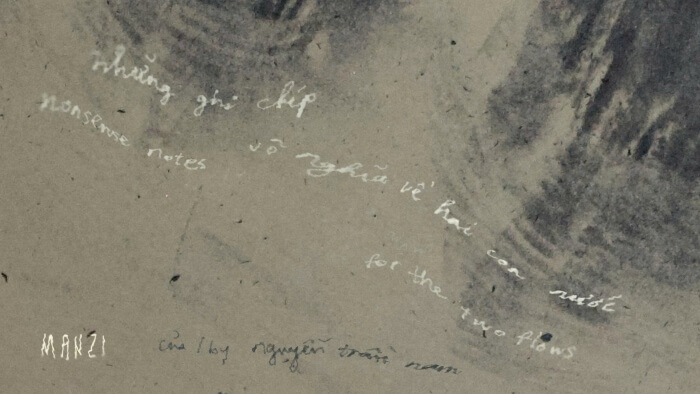
11 AM – 07 PM, Tues – Sun, 17 Nov – 10 Dec 2026
Manzi Exhibition Space
2 ngõ Hàng Bún, Ba Đình, Hà Nội
From the organizer:
A tide is a single movement of the water, rising or falling, a current running from sea into river or from river out to sea. Several tides come in and go throughout the day. They change between rivers based on geography, terrain, and tidal regime, and they vary along a single river from day to day, month to month, and season to season, influenced by a plethora of transitory weather variables. From the basic rhythm, the high tide surging into the riverbed and the ebb pulling back toward the sea, Vietnamese has evolved a broad lexicon to refer to tide occurrences, including nước kiệt, nước xiết, nước ươn, nước ngầm, nước đứng, nước dậy, nước vả, etc…. Such specialized categorization is the evidence of long-standing efforts to observe and document a motion that is both lawful and open to chance. People read the moon and the wind and thus predict the water or are caught off guard by it.
This cycle causes the river to provide both destruction and sustenance at once. Water degrades, washes away, regenerates, purifies, and cleanses. It embraces the gone while nurturing the future. A river deposits only what it has previously carried away, and it builds up one bank by eroding the other. Geology works this way, and memory perhaps does too: ceaselessly fusing anew out of ruin and rupture, fleeting and inevitable.
Two years after his last personal project, Nguyễn Trần Nam returns with nonsense notes for two flows, the result of extended investigation rooted in his recurring preoccupation with life and death. This time, the subject of his observation is two rivers woven into his own life that have held some of his most intimate memories: the Red River (Hà Nội) and the Thu Bồn River (Hội An)
Gone are the uncanny metaphors and pointed allusions the artist is known for, and the thorny questions about violence, power and belief that ran through them. The works in this open studio seem to be merely a collection of bare traces. Plain to see yet withholding, these traces are gathered over months of observing the water, and of recording and collecting along the river: found objects, unnamed fragments, and the refuse patiently handled, strung, and woven into an accumulation that need not carry any overarching meaning:
– The tarred skin of a boat burned a few years ago, its remains kneaded back together after the planks had turned to ash, now hanging like crispy pork rinds
– Fragments of bone, teeth and driftwood, salvaged from the riverbank.
– Hundreds of broken ceramic shards from sunken boats of unknown number and age, some settled in the bed of the Thu Bồn, others swept here by currents and floods from afar; now bound and twisted into a chain a full ten metres long, dragged heavily, scraping and knocking.
– A rumbling machine of absurd complexity, built only to spin a single rod, its drone rising and falling like laboured breathing
– An oversized mat, woven with swaying streaks that echo the rhythm of the Thu Bồn’s tides.
– A lone, frayed coil of fibre, binding the dried remains of one of the world’s most harmful invasive plants.
– A tiny projector bounces a hand-drawn animation off a snapped-off motorbike mirror: frames drawn in charcoal from a shrub species (Mimosa pigra), flickering like dreams of great tides.
– A mass of silt, sediment, minerals, organic humus and other unknown matter, carried in by the water and salvaged as sculptural material. Unfired and raw, it has been ground, rolled between the fingers, pressed and stacked into interlocking forms that recall forgotten sediment. It teeters on a wheelbarrow, silently soaking up each seeping drop, until the clay is soft with water and the whole mass gives way.
All these things-as-they-are lie there unconcerned, scattering in every direction imagination allows, while language falls silent. If they are anchored to one another anywhere, it is only precariously, at a shared meeting point: of fragile existences, of the remnants of what remains, and of forms changing through temporary refuges. What gathers by conditions disperses when they end. Whatever forms it takes, however many, is just nothing other than dream, illusion, bubble, shadow. Only the formless is final. And perhaps every living being, at any moment, is an accretion: layer upon layer of decay from nameless bodies, reaching back through countless deaths that came before. The tide carries away, and the tide brings back…
Please note:
– Due to the fragile nature of the installation and its immersive setup, we kindly ask all visitors to follow the guidelines below:
– Please park your vehicle at manzi 14 Phan Huy Ích or nearby parking areas. The exhibition space is just a 1-minute walk away;
– To preserve the experience and safety, the show can only accommodate a maximum of 3 visitors per slot;
– Please listen carefully and strictly follow the instructions provided by our coordinator;
– This installation is not suitable for children under the age of 15.
Follow updates on event’s page.