Group Exhibition “fiction, fraction”
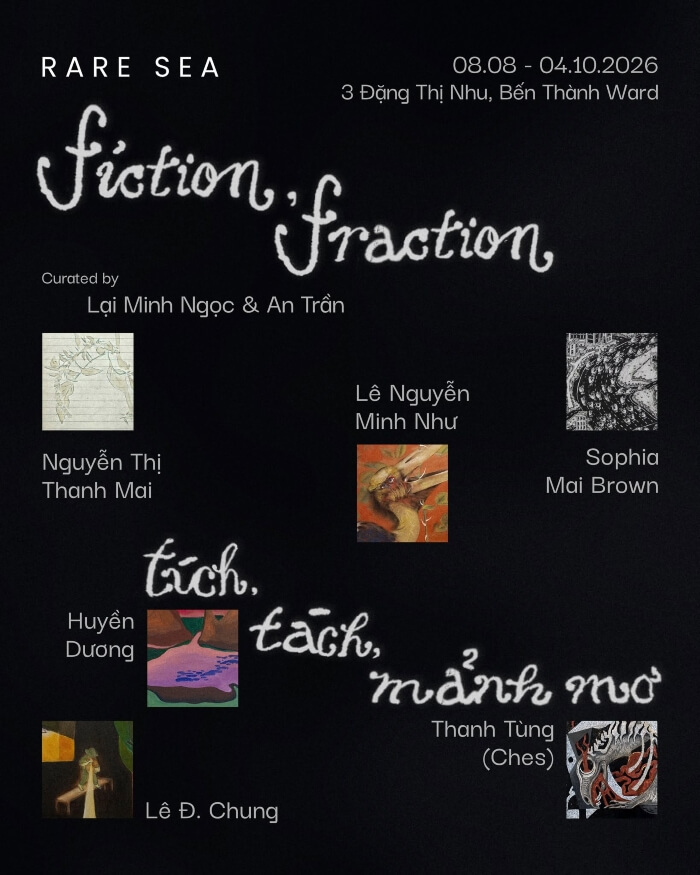
Opening: 06 PM – 08 PM, Fri 07 Aug 2026
Exhibition: 10 AM – 06 PM, Tues – Sun, 08 Aug – 04 Oct 2026
Rare Sea
3 Đặng Thị Nhu, Bến Thành ward, HCMC
Parking: TNXP parking lot – 4 Trương Định, Bến Thành Ward (900m; 2 minutes by walking)
From the organizer:
Rare Sea warmly introduces fiction, fraction, a group exhibition featuring works by Lê Đ. Chung, Lê Nguyễn Minh Như, Nguyễn Thị Thanh Mai, Huyền Dương, Thanh Tùng (Ches) and Sophia Mai Brown. Through oil painting, lacquer, hand-printed practice, silk and paper, the exhibition brings together distinct visual languages. Here, the flatness of a painting is not a limit, but an invitation into layers of gestures, materials and time that accumulate across surfaces, allowing paintings and prints to hold multiple narratives and histories. Together, these works become visual fables that transmit fragmented narratives about a society still haunted by memories of upheavals, trapped in production, and immersed in material excess.
fiction, fraction begins from whispers: sometimes as intimations from dreams, sometimes as collective silences, tracing shadows on the wall of an abandoned tea factory, lurking beneath urban soil, echoing in the taste of wild plants, lingering between the real and the imaginary.
In this turbulent era, what lullabies are better than fables and the realms of the perennial? Where imagined creatures dwell, where scenes of labor unfold as unresolved mysteries, where space and time reverse and humans remain faceless in their naming. In-between these realms, stories that seem disconnected reveal shared histories and collective memories, opening spaces for personal documentation, archival practice, translation, and interpretation beyond official narratives enforced by institutions.
Neither abstract nor deliberately realistic, the works transmit small, fragmentary stories in visual forms. These minor tales become fables that open not only pathways for escape but also alternative visions of cities, landscapes, and communities. They are stories that have always been there, murmuring faintly beneath the polished layers of the world—where small fractions accumulate into an unfinished landscape that is forever in progress.
From urban materiality and colonial archives rooted in maps, soil, dust and oral histories, Sophia Mai Brown and Thanh Tùng (Ches) challenge and expand the positioning of urban development. They open up space and time through multiple vantage points: the city reconfigured through layers of buildings, where roads become rivers and rivers become roads, overlaid onto colonial maps of Saigon; or an organic anatomy of decay unfolding beneath the street surface. Through mythical elements—worldmaking, imagined creatures, traces of local legends—the artists treat the environment not as a background but as a living character, whose voice carries through cycles of growth and decomposition.
Tracing real communities and places across past and present, Lê Đ. Chung and Nguyễn Thị Thanh Mai employ different types of visual journals to record fragments of narratives in different geographical areas. Both follow the threads of history to recount ongoing consequences of coercion. Lê Đ. Chung exploits the layers of oil paint to foreground the unresolved absurdities in the life of a post-Đổi Mới migrant community, who dwell on the remains of an abandoned factory in Lâm Đồng. On the fragility of notebook paper and carbon paper, Nguyễn Thị Thanh Mai whispers the silent relationship formed between humans and the amaranth, which resiliently carries the violence that haunts Vietnamese-Cambodian survivors of forced displacement under the Khmer Rouge from Kampong Chhnang (Cambodia)—a community still being displaced today. If Lê Đ. Chung records the rumbling conflicts of another enforcement that continues on post-colonial ruins, Nguyễn Thị Thanh Mai exposes memories through the very body of materiality itself.
Fleshing out their own fantastical realms, Huyền Dương and Lê Nguyễn Minh Như show that to dream is not to escape reality, but to remain within it. Turning inward, their works carry fragments of materiality, memory and history into dreams. Smooth brushstrokes masking layers of dark colors, Huyền Dương constructs absurdly flat worlds where tomorrow is still today, mountain is equal to tree, and oracles from 6PM sleeps are delivered through human-faced creatures and upside-down fallen angels. A humorous desacralization, she lays bare the clashes of Western and Asian aesthetic structures, affirming absurdity manifests both reality and fantasy. Lê Nguyễn Minh Như traces back the journey of being in the world and post-production society through the chain of Buddhism dependent origination. Treating silk both as a fragile surface and a land of accumulation, where every intervention leaves a trace that cannot be erased, she lays down dense passages of color, sharply meta lines and a samsara of relations. Coiling, intersecting and persisting, causes and conditions interchangeably weave together through a collection of semi-realistic fragments. As orchid grows within the claw machine, she exposes birth as a process of production, where desire is shaped before a life begins.
Obliquely mysterious, playful and sometimes poignant, yet more truthful than any master narrative, their paintings offer dreams as a way of archiving and existing otherwise.
About artists
Sophia Mai Brown (b. 2000, Vietnam) is an artist based in New York City, working in drawing and printmaking. Brown maps interactions between the natural and the built world, connecting real landscapes with imaginary inhabitants. She is the recipient of awards including the Fulbright Grant and Manhattan Graphics Center Fellowship. Brown holds a BFA in Printmaking from the Rhode Island School of Design.
Huyen Duong (b. 2001) is a multidisciplinary artist whose practice is drawn from personal experiences and everyday events. Trained in oil painting, she works across traditional materials—including textiles, papermaking, and printmaking – as well as digital tools, circuit bending, and toy making, bringing these elements together within installation-based practices.
Her current focus centers on creating spatial works responding to specific environments, integrating material, audio, and video components to deepen narrative and emotional resonance. Through the combination of handcrafted processes and experimental media systems, her practice investigates the relationship between material, movement, repetition, and sensory experience within space. Huyen’s works have been featured in the group exhibition Harsh Touch (2024) at Koganei Art Spot Chateau 2F (Tokyo, Japan) and the absurd cycle of everyday events (2026) at Toong Coworking Space (Ho Chi Minh City, Vietnam). She holds a BFA in Oil Painting from Tama Art University (Tokyo, Japan) and is currently pursuing an MA in Digital Media at the University of the Arts Bremen (Bremen, Germany).
Thanh Tùng (Ches, b. 1998, Hai Phong, Vietnam) is a multimedia artist based in Ho Chi Minh City, Vietnam. His practice is rooted in observations of everyday street life in Vietnam, where urbanization continually reshapes landscapes, ecosystems, and indigenous belief systems. Drawing on fables, urban legends, and oral histories, he constructs speculative narratives to explore what remains in the wake of these changes, reconnecting people with forms of life and traces that are gradually disappearing.
Throughout his practice, he approaches death not as an ending but as a state of transformation, in which disappearance gives rise to other modes of existence. Working within the gap between what has been lost and what is still emerging, his works evoke a sense of both familiarity and estrangement as people encounter environments shaped by continual overwriting and renewal. They reflect on how places continue to carry traces that endure beyond their visible forms.
Nguyễn Thị Thanh Mai employs various mediums such as drawing, installation, documentary film, video, and journalism to highlight issues spanning from personal narratives to broader themes of history and migration. Her works interweave research and experimentation, documentation and imagination. Exploring diverse subjects such as body, femininity, history, post-war, and migration, Mai’s art pieces are disjointed fragments that provide a window into the societal landscape she inhabits and passionately explores.
Holding a Master of Fine Arts degree from Mahasarakham University, Thailand (2012), Mai currently serves as a lecturer at University of Arts, Hue University. She received the Pollock Krasner Foundation Award in 2014 and the Artist Excellence Award in 2021 from The Factory.
Lê Nguyễn Minh Như (b. 1996) is among the few young artists in Vietnam who approaches Vietnamese silk painting through mineral pigments, rethinking a medium that has been closely tied to the aesthetics of transparent watercolors over the past century. Minh Như’s works leave a lasting impression through mineral pigments resting on the silk surface like layers of sediments, giving the works a tangible material presence through which the viewers can feel the weight of time accumulated in each stratum. This approach redefines silk as an archival surface, where memories, dreams, and elusive sensations are recorded like ecological traces. It is a contribution that expands the possibilities of the medium beyond its conventional aesthetic language and toward the realm of material painting.
The 2023 Dogma Prize marked a turning point in the critical recognition of Minh Như’s visual language. Subsequently, the duo exhibition Vọng cảnh (2023) opened a dialogue between her artistic practice and that of another artist. Since then, her presence at the Ho Chi Minh City Museum of Fine Art (2023), VCCC (2024),…have continued to shape the artistic trajectory of Lê Nguyễn Minh Như.
Lê Đ. Chung, born in 1990, lives and works in Đắk Nông. With a multidisciplinary practice that includes painting, sculpture, installation, video, and performance, Đ. Chung examines everyday events as well as working with historical and counter-historical narratives. Through this, he explores contradictions and the complexities of ongoing reality, along with the enigmatic descent of unresolved motifs and meanings from the past.
Follow updates on event’s page.