Group Exhibition “Đi vắng”
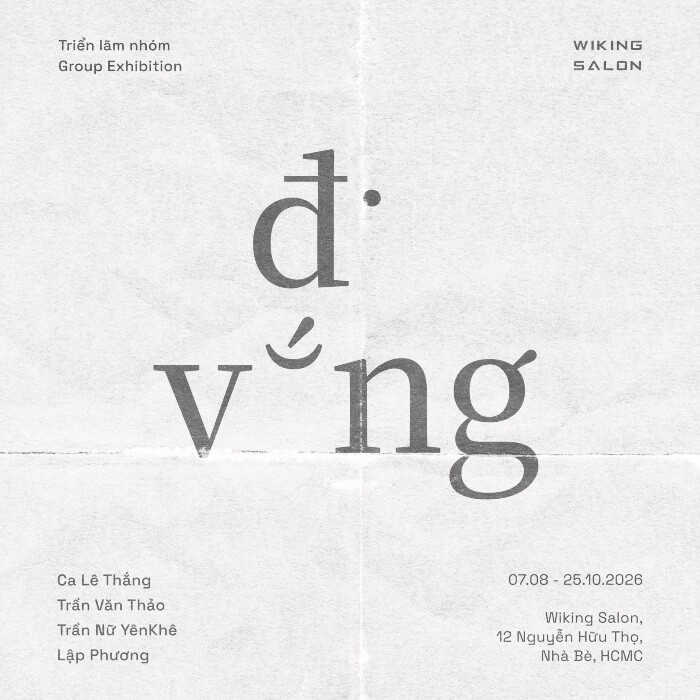
Exhibition: 10 AM – 06 PM, Tues – Sun, 07 Aug – 25 Oct 2026
Wiking Salon
12 Nguyễn Hữu Thọ, Nhà Bè, HCMC
The exhibition is open by advance appointment only.
Please DM via Facebook page to make an appointment for your visit
From the organizer:
Đi Vắng means being elsewhere temporarily, or stepping away while leaving traces of one’s presence behind. In this exhibition of the same title, works by Lập Phương, Trần Nữ YênKhê, Trần Văn Thảo, and Ca Lê Thắng unfold through a shared language of abstraction, each with their own distinctive approaches. Solid and undefined forms co-exist alongside, then dissolve into fluid currents of colours and undefined lines, raising a central question: have specific images or meanings of these abstract works vanished, or do they persist as physical traces in another invisible form?
About artists
Lap Phuong (b.1989) graduated with a major in monumental sculpture from Hanoi University of Architecture. She established her art style early from her very first sheet metal sculptures.
Values of sculptures may arise from the nature of their materials, nurturing basic senses, including human instinctive stimulations through touching. Objects through Phuong’s creation are fusion of surfaces and arrays into patterns of combinations with symmetrical structures; keen and fragile shapes that allow primitive materials to evoke, with a main focus to follow rhythms of movements that are both dramatic and in harmony. The overall impressions are minimal, sometimes highlight sharp details as reminding the sketchy style in ancient East Asian poems.
Series of Wings – Arcs – Triangles – Infinity… correspond to inevitable movement sequences from being agonistic to antagonistic and synergistic; overlaying the state of mind of a traveler who aspires for integrations of human to human and human to the natural world. The mind merges with the external world, the inner becomes one with the outer. The presence of Phuong’s works is to form, occupy and belong to the space. This way of dealing with physical and psychological spaces allows each artwork to contain an aspiration for the stature of monumental sculpture – reminding human wisdom and intuition in space-time realms.
Grasping laws of permanence, modularizing monads on the basis of materials that tends to be ephemeral; Lap Phuong’s works are increasingly multi-dimensional evolving, escaping structures and laws, approaching emptiness, infinity, and impermanence.
Working across sculpture, painting and cinema, Paris-based artist Tran Nu YenKhe creates worlds where light and shadow engage in a subtle dance and tensions between form and material play out. Tran’s work doesn’t strive to represent or recreate specific imagery, but rather dynamic, abstract forms elicit a range of emotions and imagined narratives in a poetic language that underscores the complexity and contradictions of human behavior.
Tran Nu YenKhe studied at the prestigious École Camondo, a private school of product design and interior architecture in Paris. The artist’s Borderline (2018), a striking sculpture made of traditional Vietnamese lacquer, was acquired in 2019 by Musée Guimet in Paris, making history as the first contemporary artwork from Southeast Asia to be included in the French National Collections. Alongside her visual art practice, Tran has built a distinguished career in film over the last 30 years as the lead actress in The Scent of Green Papaya (1993), Cyclo (1995), and The Vertical Ray of the Sun (2000), among others, and recently served as Art Director and Costume Designer for The Taste of Things (2023), directed by Tran Anh Hung — winner of the Best Director Award at the 76th Cannes Film Festival.
Tran Van Thao (b. 1961, Saigon), one of Vietnam’s foremost abstract painters, is recognized for his individual markings, rich colour fields, and compositions that convey a sense of harmony and balance through a contemplative atmosphere that invites introspection and mindfulness. For Tran, inspiration comes from the humble yet dynamic experience of everyday life, as well as the immediacy of his surroundings.
Tran Van Thao belongs to an influential group of painters who rose to prominence in the 90s following the 1986 Doi Moi economic reforms. Part of the historic Group of 10 artists that catalysed the process to recognise abstraction as a legitimate genre of the visual arts in Vietnam, Tran was one of the group’s most prominent members.
Tran graduated from the Ho Chi Minh University of Fine Arts in 1986, and has since held numerous exhibitions across Asia, Europe, and the U.S. Selected international exhibitions include Out of Context, Huntington Beach Art Center, Huntington Beach, California, USA; Art Festival for World Peace, Seoul Arts Center, Seoul, Korea; ASEAN Art Awards, National Art Gallery, Kuala Lumpur, Malaysia; On the Horizon, Pacific Bridge Contemporary Southeast Asian Art, Oakland, California, USA; L’Anima Soffocata, Museo Biblioteca Archivio, Bassano del Grappa, Italy; Paris, Hanoi, Saigon: The Adventures of Modern Art in Vietnam, Pavillon des Arts, Paris, France; The Finest Collection from Sister Cities, Busan Metropolitan Art Museum, Busan, Korea; Man and Woman, H&S Gallery, Brussels, Belgium, travelled to Paris, Tokyo, San Francisco, Singapore; From the Red River to the Mekong: The New Trend in Vietnamese Art, Centre Wallonie-Bruxelles, Paris, France; A Winding River: The Journey of Contemporary Art in Vietnam, Meridian International Center, Washington, D.C., USA, travelled to various venues in the United States; 11th International Contemporary Asian Art Exhibition, Metropolitan Museum of Manila, Philippines; Vietnamese Art After Doi Moi, Fujita Vente Art Museum, Tokyo, Japan; 10th International Contemporary Asian Art Exhibition, National Museum Art Gallery, Singapore; and Contemporary Vietnamese Art Exhibition, Tropical Museum, The Hague, Holland. In 2001, he was the recipient of the Asian Cultural Council’s Starr Foundation Fellowship and spent four months as an artist-in-residence in New York.
Tran is currently based in Ho Chi Minh City, Vietnam.
Ca Lê Thắng (b.1949) , spent his childhood in Đồng Tháp Mười resistance zone, Vietnam. After the Geneva Accords were signed in 1954, he moved with his family to Hanoi in 1955 as part of the national regrouping program.
Ca Lê Thắng’s father served as the Director of the Social Sciences Library in Hanoi. This connection allowed him early access to a variety of books, documents, and information from foreign sources and Southern Vietnam during the early 1970s. Despite studying art within the Socialist Realism educational framework, he developed an early curiosity and began experimenting with Cubism in 1975, gradually transitioning to Abstract during the 80s.
After Vietnam’s reunification, Ca Lê Thắng returned to Southern Vietnam in 1976, where he served as a lecturer at the Ho Chi Minh City University of Fine Arts until 1988. From 1988 to 2000, he was the Permanent Deputy General Secretary of the Ho Chi Minh City Fine Arts Association.
Since his graduation, he has consistently participated in numerous art exhibitions of various scales within Vietnam. During his most prolific period, from the late 1980s to 2000, he exhibited internationally at venues such as the Fujita Venté Museum (Tokyo, Japan), the Metropolitan Museum of Manila (Manila, Philippines), and other exhibitions in Switzerland, South Korea, Singapore, and more.
As a member of the Group of 10 (Nguyễn Trung, Đào Minh Tri, Ca Lê Thắng, Nguyễn Tấn Cương, Đỗ Hoàng Tường, Trần Văn Thảo, Hứa Thanh Bình, Nguyễn Trung Tín, Vũ Hà Nam, Nguyễn Thanh Bình), he regularly showcased his works at the “Recent Works” group exhibitions from 1989 to 1995, contributing to the revival of abstract painting throughout the country. Additionally, alongside Nguyễn Trung, he co-founded and managed the Ho Chi Minh City Fine Arts Journal, an influential publication released from 1991 to 1996.
For his significant contributions to Vietnamese art, he received numerous awards from the Ho Chi Minh City Fine Arts Association and the Vietnam Fine Arts Association. His works have been preserved in the collections of the Vietnam Museum of Fine Arts, the Ho Chi Minh City Museum of Fine Arts, and the Quang San Art Museum.